
.svg)

Tutoring works when the hour your child spends with their tutor is the hub of a wider weekly routine — not a stand-alone fix. Parents who get the most out of tutoring tend to do the same eight things: set one clear goal, prep three questions before each session, stay close enough to know what's happening without hovering, follow up within 24 hours, build short retrieval practice between sessions, talk to the tutor every two to three weeks, watch for the right early signals, and escalate calmly if something stalls. This guide walks through each move in the order it happens, with the parent and student steps that make tutoring at A$65/hour (Australia) or US$45/hour (US) the best-value support hour in the week.
Quick answer: Pick one specific goal, write three questions before each session, sit close by for the first three sessions then step back, schedule a 10-minute follow-up the same day, and ask the tutor for a short progress note every two to three weeks. The biggest single lever is the 10–15 minutes of retrieval practice your child does between sessions — without it, even an excellent tutor is starting from cold every week.

How do I get the most out of a tutoring session?
Treat each session as one stage of a three-part loop: prep, session, follow-up. Before the session, your child writes one specific goal and three questions on a notepad — pulled from the worksheet, marked test, or topic that's giving them trouble. During the session, they bring real work (an actual assignment, a returned quiz, a textbook page) so the tutor can teach against it rather than against an abstract syllabus. After the session, your child spends 10 minutes that same day re-doing one problem the tutor walked them through, in their own words. Cornell University's tutoring guidance puts this plainly: come with specific questions, attempt the work first, and expect the tutor to ask you questions back. The session is high-leverage when your child arrives ready to learn the next thing, not ready to be diagnosed from scratch.
Sessions that drift usually skip the prep step. If your child rocks up to the call with no notes, no marked work, and no specific question, the first 10–15 minutes of a 60-minute session goes to working out what to focus on — that's a quarter of the hour you're paying for, gone. The fix is small: a five-minute pre-session habit, started by you the first three weeks, then run by your child.
What should my child do to prepare for a tutoring session?
Five minutes of preparation, repeated every week, is the single biggest predictor of whether a tutoring relationship pays off. Have your child do four things before each session: (1) reopen the work they did last session and read their own notes; (2) attempt one new question on the topic and circle the spot they get stuck; (3) write three specific questions on a sticky note — "I don't get how to factorise when there's no common factor" beats "I don't get algebra"; (4) put the marked schoolwork, the textbook, and a fresh notebook on the desk before the call starts. This is the loop Cornell's Learning Strategies Center recommends for college tutees, and it works the same way for primary, lower-secondary, and senior students.
For Year 1–6 students, you do the prep with them, not for them — sit beside them, ask "what do you want to ask your tutor today?", and write the three questions in their words. By Year 7 or 8 most students can run the routine themselves; your job becomes a 30-second checkpoint at the door: "Got your three questions? Got the marked test? Notebook open?" For senior students preparing for the HSC, VCE, ATAR, SAT or AP exams, swap the sticky note for a tracked question log — keep one running list of every question they couldn't solve in the past week, and bring the top three to the session.
Should I sit in on my child's tutoring sessions?
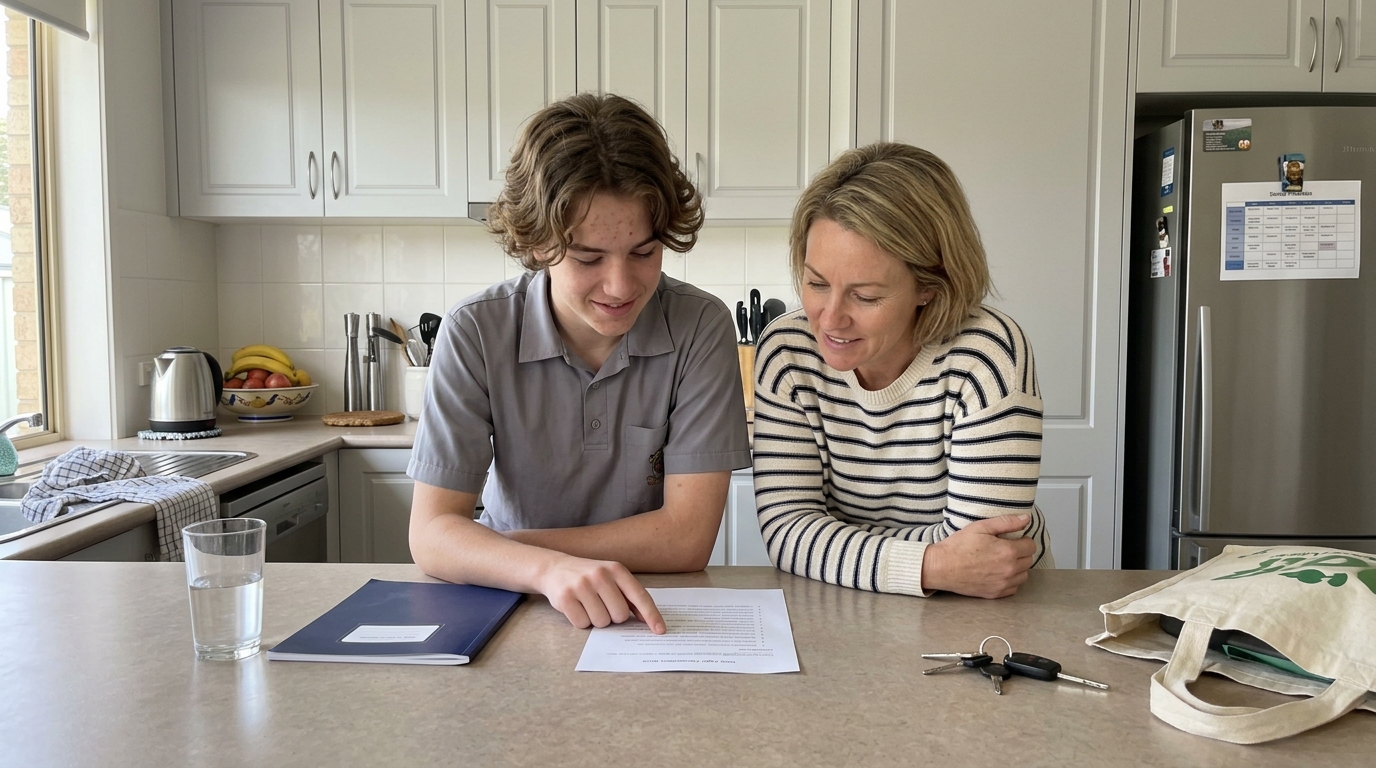
For the first three sessions, sit close enough to hear without being in the camera or in the room — the next room with the door open is ideal. You're listening for two things: whether the tutor is teaching content (good) or doing the work for your child (bad), and whether your child is asking questions or just nodding along. After three sessions, step back. For Year 1–4 students, "close by" can mean at the same kitchen table on a different task — your physical presence keeps young students on track and lets you see when your child has a private smile of "I just got that". For Year 5 and up, your presence in the room can flatten the conversation; students hold back questions when a parent is watching. The goal is being available, not present.
If your child has ADHD, anxiety, or is new to tutoring, extend the "close by" phase to five or six sessions before stepping back. The signal you want to see is your child volunteering questions to the tutor without looking to you for permission — that's the moment they've taken ownership of the hour.
What's the best way to follow up after a tutoring session?
The 24 hours after a session matter more than the hour itself. Within an hour of finishing, your child re-does one problem the tutor walked them through, in their own notebook, without looking at the worked example. The next day, they redo it again from memory. This is retrieval practice — the most reliably effective study technique in the cognitive-science literature, documented by Roediger and Karpicke (2006) and replicated across hundreds of classroom studies. A 10-minute redo within 24 hours retains roughly twice as much as re-reading the notes for the same time.
Build it as a routine: same desk, same notebook, same time of day (right after dinner works for most families). For primary students, you sit with them and ask "show me how you solved it" — they explain back, you nod. For secondary students, the rule is "redo the question, then text Mum or Dad a photo of your working" — the photo is the accountability mechanism, not a check on accuracy. The tutor will pick up the accuracy at the next session.
How can I tell if a tutoring session went well?
Three signals tell you a session was useful, none of them is "my child enjoyed it" on its own. First, your child can explain back at least one thing they learned in their own words within 24 hours — not just "we did fractions" but "we did fractions and the trick is you flip the second one and times it". Second, the tutor sent a short note (two or three lines, or a short voice memo) saying what was covered and what to practise. Third, the next time your child opens the same kind of question, they get further before getting stuck — even if they don't get it right.
Watch for false-positive signals too. A session can feel great and still be drift: lots of warmth, lots of laughs, your child says "yeah we did some maths". If you ask them what they did and they can't tell you one specific thing, the tutor is being friendly rather than effective. The fix is rarely a new tutor — it's giving the existing tutor a clear goal at the start of next session.
How often should I check in with my child's tutor?
Aim for a 10–15 minute check-in with the tutor every two to three weeks, plus a short written update from the tutor after every session. The cadence is enough to catch drift early without burdening either side. Use the check-in for three things: (1) what's working — what concepts are clicking; (2) what's not — where's your child still stuck; (3) the next two-week goal — what would good look like by the next check-in. Most tutoring services build this kind of update cadence in by default; with Tutero, parents get a session-level note plus a fortnightly summary as part of the weekly hour.
Skip the check-in only when everything is obviously working — and even then, don't skip it for more than six weeks. Tutoring relationships drift slowly; by the time the slide is obvious to your child, you've often paid for four or five low-value sessions.
What should I do if my child isn't engaged during tutoring?
Disengagement during sessions is almost always one of three things, and the fix is different for each. If your child is bored, the work is too easy or too repetitive — ask the tutor to lift the difficulty by half a step or change the topic to something live in their schoolwork that week. If your child is overwhelmed, the work is too hard — ask the tutor to drop back to the prerequisite topic and rebuild. If your child is anxious, the issue is rarely the maths or the writing — it's the dynamic with the tutor; one or two more weeks of the "close by" parent presence usually unlocks it.
The fastest diagnostic is a one-question conversation right after a flat session: "if you could change one thing about that session, what would it be?" Primary students will tell you straight; secondary students might shrug, in which case offer three options — "too easy, too hard, or just not in the mood?" If the same answer comes back twice in a row, raise it with the tutor at the next check-in. If three sessions in a row are flat after you've tried both fixes, that's a signal to ask the service to swap the tutor — not your child's fault, and not the tutor's; some pairings just don't click.
How do I help my child practise between tutoring sessions?
Aim for 10–15 minutes of practice on three days between sessions — never more than 20 minutes, never zero. The practice is short retrieval, not new learning: redo problems the tutor already taught, in their own notebook, without looking. The Education Endowment Foundation's metacognition guidance recommends students explain their own reasoning aloud during practice — "I did this step because…" — which deepens the encoding and surfaces gaps for the next session. For primary students, you can be the audience; for secondary, the explanation can be in writing in the margin of the notebook.
Spaced repetition matters more than total minutes. Three 10-minute sessions across the week beat one 30-minute block on Sunday. Use a simple roster: short practice on Tuesday, short practice on Thursday, short practice on Saturday. If your child is in a peak homework week, drop the Saturday session — never drop the Tuesday one, because that's the one that catches what was forgotten on Monday. If your child is preparing for an exam, layer past-paper questions on top of the standard retrieval — see the study time-management guide for full week templates.
What does tutoring at A$65 an hour actually buy you when you do it well?
At A$65 per hour in Australia or US$45 per hour in the United States, an hour with a Tutero tutor is the same rate whether your child is in Year 1, Year 9, or sitting their HSC, VCE, ATAR, IB, SAT or AP exams — there's no senior premium and no contracts. The value comes from compounding the hour: the prep loop turns a "general help" hour into "targeted work on this week's misconception", the retrieval practice turns one hour of teaching into three or four exposures across the week, and the fortnightly check-in keeps the next hour pointed at the right thing. Families who run the eight moves in this guide consistently see measurable progress within three to four weeks; families who pay for the hour but skip the prep, the retrieval, and the check-ins typically see slower change and pay for the same lesson twice.
If you're still choosing a tutor, the prep, sit-in, follow-up loop also doubles as the fastest way to evaluate one — see how to know if your child is getting value from their tutor for the four-week eval template, and the seven signs of a good tutor for the in-session signals to watch.
The 8-move parent checklist for every tutoring week
- Set one specific goal for the fortnight, written down where your child can see it.
- Prep three questions together five minutes before the session — written, on the desk.
- Sit close by for the first three sessions, then step back to the next room.
- Schedule a 10-minute redo the same day as the session, same time of day each week.
- Run two short retrieval blocks midweek (Tuesday + Thursday work for most families).
- Read the tutor's session note with your child — point at one win, name one thing to fix next time.
- Hold a 10-minute check-in with the tutor every two to three weeks — what's working, what's not, next goal.
- Watch the engagement signal — if three sessions in a row are flat, raise it with the tutor or the service.
What gets in the way of getting the most out of tutoring?
Three things, almost always. The first is treating tutoring as a delivery service — the hour arrives, the hour finishes, the hour is forgotten until next week. Without the 10–15 minutes of retrieval practice and the redo within 24 hours, your child is starting cold every session, and the tutor spends 15 minutes of every hour rebuilding context. The second is a vague goal — "improve at maths" or "do better in English" doesn't give the tutor anywhere to aim, and a session without an aim defaults to whatever your child happens to bring up. The third is silent drift — when sessions go flat for three weeks running and nobody tells the tutor; the tutor assumes things are fine, your child gives up asking questions, and the relationship slowly degrades. The eight-move checklist exists to catch all three before they compound.
Bottom line
The best hour your family pays for in the week is the tutoring hour, but only when it's the centre of a routine — not a one-off transaction. Five minutes of prep, 10 minutes of follow-up, two short retrieval blocks midweek, and a fortnightly check-in turn an A$65 hour into something measurably bigger than the hour itself. None of the moves in this guide cost extra money. They cost about 35–40 minutes of your time across the week, and they're the difference between paying for tutoring and getting full value from tutoring.
Ready to make every tutoring session count for your child?
Tutero matches your child with a personally chosen tutor at A$65 per hour — same rate Year 1 through ATAR, no contracts, with a fortnightly written progress note included. Book your first lesson with no sign-up fee and pay after each lesson. We'll help you set up the prep–session–follow-up loop in the first week.
Five minutes of prep, 10 minutes of follow-up, and two short retrieval blocks midweek turn an A$65 hour into something measurably bigger than the hour itself.
Five minutes of prep, 10 minutes of follow-up, and two short retrieval blocks midweek turn an A$65 hour into something measurably bigger than the hour itself.
Tutoring works when the hour your child spends with their tutor is the hub of a wider weekly routine — not a stand-alone fix. Parents who get the most out of tutoring tend to do the same eight things: set one clear goal, prep three questions before each session, stay close enough to know what's happening without hovering, follow up within 24 hours, build short retrieval practice between sessions, talk to the tutor every two to three weeks, watch for the right early signals, and escalate calmly if something stalls. This guide walks through each move in the order it happens, with the parent and student steps that make tutoring at A$65/hour (Australia) or US$45/hour (US) the best-value support hour in the week.
Quick answer: Pick one specific goal, write three questions before each session, sit close by for the first three sessions then step back, schedule a 10-minute follow-up the same day, and ask the tutor for a short progress note every two to three weeks. The biggest single lever is the 10–15 minutes of retrieval practice your child does between sessions — without it, even an excellent tutor is starting from cold every week.
How do I get the most out of a tutoring session?
Treat each session as one stage of a three-part loop: prep, session, follow-up. Before the session, your child writes one specific goal and three questions on a notepad — pulled from the worksheet, marked test, or topic that's giving them trouble. During the session, they bring real work (an actual assignment, a returned quiz, a textbook page) so the tutor can teach against it rather than against an abstract syllabus. After the session, your child spends 10 minutes that same day re-doing one problem the tutor walked them through, in their own words. Cornell University's tutoring guidance puts this plainly: come with specific questions, attempt the work first, and expect the tutor to ask you questions back. The session is high-leverage when your child arrives ready to learn the next thing, not ready to be diagnosed from scratch.
Sessions that drift usually skip the prep step. If your child rocks up to the call with no notes, no marked work, and no specific question, the first 10–15 minutes of a 60-minute session goes to working out what to focus on — that's a quarter of the hour you're paying for, gone. The fix is small: a five-minute pre-session habit, started by you the first three weeks, then run by your child.
What should my child do to prepare for a tutoring session?
Five minutes of preparation, repeated every week, is the single biggest predictor of whether a tutoring relationship pays off. Have your child do four things before each session: (1) reopen the work they did last session and read their own notes; (2) attempt one new question on the topic and circle the spot they get stuck; (3) write three specific questions on a sticky note — "I don't get how to factorise when there's no common factor" beats "I don't get algebra"; (4) put the marked schoolwork, the textbook, and a fresh notebook on the desk before the call starts. This is the loop Cornell's Learning Strategies Center recommends for college tutees, and it works the same way for primary, lower-secondary, and senior students.
For Year 1–6 students, you do the prep with them, not for them — sit beside them, ask "what do you want to ask your tutor today?", and write the three questions in their words. By Year 7 or 8 most students can run the routine themselves; your job becomes a 30-second checkpoint at the door: "Got your three questions? Got the marked test? Notebook open?" For senior students preparing for the HSC, VCE, ATAR, SAT or AP exams, swap the sticky note for a tracked question log — keep one running list of every question they couldn't solve in the past week, and bring the top three to the session.
Should I sit in on my child's tutoring sessions?
For the first three sessions, sit close enough to hear without being in the camera or in the room — the next room with the door open is ideal. You're listening for two things: whether the tutor is teaching content (good) or doing the work for your child (bad), and whether your child is asking questions or just nodding along. After three sessions, step back. For Year 1–4 students, "close by" can mean at the same kitchen table on a different task — your physical presence keeps young students on track and lets you see when your child has a private smile of "I just got that". For Year 5 and up, your presence in the room can flatten the conversation; students hold back questions when a parent is watching. The goal is being available, not present.
If your child has ADHD, anxiety, or is new to tutoring, extend the "close by" phase to five or six sessions before stepping back. The signal you want to see is your child volunteering questions to the tutor without looking to you for permission — that's the moment they've taken ownership of the hour.
What's the best way to follow up after a tutoring session?
The 24 hours after a session matter more than the hour itself. Within an hour of finishing, your child re-does one problem the tutor walked them through, in their own notebook, without looking at the worked example. The next day, they redo it again from memory. This is retrieval practice — the most reliably effective study technique in the cognitive-science literature, documented by Roediger and Karpicke (2006) and replicated across hundreds of classroom studies. A 10-minute redo within 24 hours retains roughly twice as much as re-reading the notes for the same time.
Build it as a routine: same desk, same notebook, same time of day (right after dinner works for most families). For primary students, you sit with them and ask "show me how you solved it" — they explain back, you nod. For secondary students, the rule is "redo the question, then text Mum or Dad a photo of your working" — the photo is the accountability mechanism, not a check on accuracy. The tutor will pick up the accuracy at the next session.
How can I tell if a tutoring session went well?
Three signals tell you a session was useful, none of them is "my child enjoyed it" on its own. First, your child can explain back at least one thing they learned in their own words within 24 hours — not just "we did fractions" but "we did fractions and the trick is you flip the second one and times it". Second, the tutor sent a short note (two or three lines, or a short voice memo) saying what was covered and what to practise. Third, the next time your child opens the same kind of question, they get further before getting stuck — even if they don't get it right.
Watch for false-positive signals too. A session can feel great and still be drift: lots of warmth, lots of laughs, your child says "yeah we did some maths". If you ask them what they did and they can't tell you one specific thing, the tutor is being friendly rather than effective. The fix is rarely a new tutor — it's giving the existing tutor a clear goal at the start of next session.
How often should I check in with my child's tutor?
Aim for a 10–15 minute check-in with the tutor every two to three weeks, plus a short written update from the tutor after every session. The cadence is enough to catch drift early without burdening either side. Use the check-in for three things: (1) what's working — what concepts are clicking; (2) what's not — where's your child still stuck; (3) the next two-week goal — what would good look like by the next check-in. Most tutoring services build this kind of update cadence in by default; with Tutero, parents get a session-level note plus a fortnightly summary as part of the weekly hour.
Skip the check-in only when everything is obviously working — and even then, don't skip it for more than six weeks. Tutoring relationships drift slowly; by the time the slide is obvious to your child, you've often paid for four or five low-value sessions.
What should I do if my child isn't engaged during tutoring?
Disengagement during sessions is almost always one of three things, and the fix is different for each. If your child is bored, the work is too easy or too repetitive — ask the tutor to lift the difficulty by half a step or change the topic to something live in their schoolwork that week. If your child is overwhelmed, the work is too hard — ask the tutor to drop back to the prerequisite topic and rebuild. If your child is anxious, the issue is rarely the maths or the writing — it's the dynamic with the tutor; one or two more weeks of the "close by" parent presence usually unlocks it.
The fastest diagnostic is a one-question conversation right after a flat session: "if you could change one thing about that session, what would it be?" Primary students will tell you straight; secondary students might shrug, in which case offer three options — "too easy, too hard, or just not in the mood?" If the same answer comes back twice in a row, raise it with the tutor at the next check-in. If three sessions in a row are flat after you've tried both fixes, that's a signal to ask the service to swap the tutor — not your child's fault, and not the tutor's; some pairings just don't click.
How do I help my child practise between tutoring sessions?
Aim for 10–15 minutes of practice on three days between sessions — never more than 20 minutes, never zero. The practice is short retrieval, not new learning: redo problems the tutor already taught, in their own notebook, without looking. The Education Endowment Foundation's metacognition guidance recommends students explain their own reasoning aloud during practice — "I did this step because…" — which deepens the encoding and surfaces gaps for the next session. For primary students, you can be the audience; for secondary, the explanation can be in writing in the margin of the notebook.
Spaced repetition matters more than total minutes. Three 10-minute sessions across the week beat one 30-minute block on Sunday. Use a simple roster: short practice on Tuesday, short practice on Thursday, short practice on Saturday. If your child is in a peak homework week, drop the Saturday session — never drop the Tuesday one, because that's the one that catches what was forgotten on Monday. If your child is preparing for an exam, layer past-paper questions on top of the standard retrieval — see the study time-management guide for full week templates.
What does tutoring at A$65 an hour actually buy you when you do it well?
At A$65 per hour in Australia or US$45 per hour in the United States, an hour with a Tutero tutor is the same rate whether your child is in Year 1, Year 9, or sitting their HSC, VCE, ATAR, IB, SAT or AP exams — there's no senior premium and no contracts. The value comes from compounding the hour: the prep loop turns a "general help" hour into "targeted work on this week's misconception", the retrieval practice turns one hour of teaching into three or four exposures across the week, and the fortnightly check-in keeps the next hour pointed at the right thing. Families who run the eight moves in this guide consistently see measurable progress within three to four weeks; families who pay for the hour but skip the prep, the retrieval, and the check-ins typically see slower change and pay for the same lesson twice.
If you're still choosing a tutor, the prep, sit-in, follow-up loop also doubles as the fastest way to evaluate one — see how to know if your child is getting value from their tutor for the four-week eval template, and the seven signs of a good tutor for the in-session signals to watch.
The 8-move parent checklist for every tutoring week
- Set one specific goal for the fortnight, written down where your child can see it.
- Prep three questions together five minutes before the session — written, on the desk.
- Sit close by for the first three sessions, then step back to the next room.
- Schedule a 10-minute redo the same day as the session, same time of day each week.
- Run two short retrieval blocks midweek (Tuesday + Thursday work for most families).
- Read the tutor's session note with your child — point at one win, name one thing to fix next time.
- Hold a 10-minute check-in with the tutor every two to three weeks — what's working, what's not, next goal.
- Watch the engagement signal — if three sessions in a row are flat, raise it with the tutor or the service.
What gets in the way of getting the most out of tutoring?
Three things, almost always. The first is treating tutoring as a delivery service — the hour arrives, the hour finishes, the hour is forgotten until next week. Without the 10–15 minutes of retrieval practice and the redo within 24 hours, your child is starting cold every session, and the tutor spends 15 minutes of every hour rebuilding context. The second is a vague goal — "improve at maths" or "do better in English" doesn't give the tutor anywhere to aim, and a session without an aim defaults to whatever your child happens to bring up. The third is silent drift — when sessions go flat for three weeks running and nobody tells the tutor; the tutor assumes things are fine, your child gives up asking questions, and the relationship slowly degrades. The eight-move checklist exists to catch all three before they compound.
Bottom line
The best hour your family pays for in the week is the tutoring hour, but only when it's the centre of a routine — not a one-off transaction. Five minutes of prep, 10 minutes of follow-up, two short retrieval blocks midweek, and a fortnightly check-in turn an A$65 hour into something measurably bigger than the hour itself. None of the moves in this guide cost extra money. They cost about 35–40 minutes of your time across the week, and they're the difference between paying for tutoring and getting full value from tutoring.
Ready to make every tutoring session count for your child?
Tutero matches your child with a personally chosen tutor at A$65 per hour — same rate Year 1 through ATAR, no contracts, with a fortnightly written progress note included. Book your first lesson with no sign-up fee and pay after each lesson. We'll help you set up the prep–session–follow-up loop in the first week.
FAQ
.svg)
.svg)
Online maths tutoring at Tutero is catering to students of all year levels. We offer programs tailored to the unique learning curves of each age group.
We also have expert NAPLAN and ATAR subject tutors, ensuring students are well-equipped for these pivotal assessments.
We recommend at least two to three session per week for consistent progress. However, this can vary based on your child's needs and goals.
Our platform uses advanced security protocols to ensure the safety and privacy of all our online sessions.
Parents are welcome to observe sessions. We believe in a collaborative approach to education.
We provide regular progress reports and assessments to track your child’s academic development.
Yes, we prioritise the student-tutor relationship and can arrange a change if the need arises.
Yes, we offer a range of resources and materials, including interactive exercises and practice worksheets.
Five minutes of prep, 10 minutes of follow-up, and two short retrieval blocks midweek turn an A$65 hour into something measurably bigger than the hour itself.
Five minutes of prep, 10 minutes of follow-up, and two short retrieval blocks midweek turn an A$65 hour into something measurably bigger than the hour itself.

Five minutes of prep, 10 minutes of follow-up, and two short retrieval blocks midweek turn an A$65 hour into something measurably bigger than the hour itself.
The hour your child spends with their tutor is the hub of a wider weekly routine — not a stand-alone fix.
Tutoring works when the hour your child spends with their tutor is the hub of a wider weekly routine — not a stand-alone fix. Parents who get the most out of tutoring tend to do the same eight things: set one clear goal, prep three questions before each session, stay close enough to know what's happening without hovering, follow up within 24 hours, build short retrieval practice between sessions, talk to the tutor every two to three weeks, watch for the right early signals, and escalate calmly if something stalls. This guide walks through each move in the order it happens, with the parent and student steps that make tutoring at A$65/hour (Australia) or US$45/hour (US) the best-value support hour in the week.
Quick answer: Pick one specific goal, write three questions before each session, sit close by for the first three sessions then step back, schedule a 10-minute follow-up the same day, and ask the tutor for a short progress note every two to three weeks. The biggest single lever is the 10–15 minutes of retrieval practice your child does between sessions — without it, even an excellent tutor is starting from cold every week.
How do I get the most out of a tutoring session?
Treat each session as one stage of a three-part loop: prep, session, follow-up. Before the session, your child writes one specific goal and three questions on a notepad — pulled from the worksheet, marked test, or topic that's giving them trouble. During the session, they bring real work (an actual assignment, a returned quiz, a textbook page) so the tutor can teach against it rather than against an abstract syllabus. After the session, your child spends 10 minutes that same day re-doing one problem the tutor walked them through, in their own words. Cornell University's tutoring guidance puts this plainly: come with specific questions, attempt the work first, and expect the tutor to ask you questions back. The session is high-leverage when your child arrives ready to learn the next thing, not ready to be diagnosed from scratch.
Sessions that drift usually skip the prep step. If your child rocks up to the call with no notes, no marked work, and no specific question, the first 10–15 minutes of a 60-minute session goes to working out what to focus on — that's a quarter of the hour you're paying for, gone. The fix is small: a five-minute pre-session habit, started by you the first three weeks, then run by your child.
What should my child do to prepare for a tutoring session?
Five minutes of preparation, repeated every week, is the single biggest predictor of whether a tutoring relationship pays off. Have your child do four things before each session: (1) reopen the work they did last session and read their own notes; (2) attempt one new question on the topic and circle the spot they get stuck; (3) write three specific questions on a sticky note — "I don't get how to factorise when there's no common factor" beats "I don't get algebra"; (4) put the marked schoolwork, the textbook, and a fresh notebook on the desk before the call starts. This is the loop Cornell's Learning Strategies Center recommends for college tutees, and it works the same way for primary, lower-secondary, and senior students.
For Year 1–6 students, you do the prep with them, not for them — sit beside them, ask "what do you want to ask your tutor today?", and write the three questions in their words. By Year 7 or 8 most students can run the routine themselves; your job becomes a 30-second checkpoint at the door: "Got your three questions? Got the marked test? Notebook open?" For senior students preparing for the HSC, VCE, ATAR, SAT or AP exams, swap the sticky note for a tracked question log — keep one running list of every question they couldn't solve in the past week, and bring the top three to the session.
Should I sit in on my child's tutoring sessions?
For the first three sessions, sit close enough to hear without being in the camera or in the room — the next room with the door open is ideal. You're listening for two things: whether the tutor is teaching content (good) or doing the work for your child (bad), and whether your child is asking questions or just nodding along. After three sessions, step back. For Year 1–4 students, "close by" can mean at the same kitchen table on a different task — your physical presence keeps young students on track and lets you see when your child has a private smile of "I just got that". For Year 5 and up, your presence in the room can flatten the conversation; students hold back questions when a parent is watching. The goal is being available, not present.
If your child has ADHD, anxiety, or is new to tutoring, extend the "close by" phase to five or six sessions before stepping back. The signal you want to see is your child volunteering questions to the tutor without looking to you for permission — that's the moment they've taken ownership of the hour.
What's the best way to follow up after a tutoring session?
The 24 hours after a session matter more than the hour itself. Within an hour of finishing, your child re-does one problem the tutor walked them through, in their own notebook, without looking at the worked example. The next day, they redo it again from memory. This is retrieval practice — the most reliably effective study technique in the cognitive-science literature, documented by Roediger and Karpicke (2006) and replicated across hundreds of classroom studies. A 10-minute redo within 24 hours retains roughly twice as much as re-reading the notes for the same time.
Build it as a routine: same desk, same notebook, same time of day (right after dinner works for most families). For primary students, you sit with them and ask "show me how you solved it" — they explain back, you nod. For secondary students, the rule is "redo the question, then text Mum or Dad a photo of your working" — the photo is the accountability mechanism, not a check on accuracy. The tutor will pick up the accuracy at the next session.
How can I tell if a tutoring session went well?
Three signals tell you a session was useful, none of them is "my child enjoyed it" on its own. First, your child can explain back at least one thing they learned in their own words within 24 hours — not just "we did fractions" but "we did fractions and the trick is you flip the second one and times it". Second, the tutor sent a short note (two or three lines, or a short voice memo) saying what was covered and what to practise. Third, the next time your child opens the same kind of question, they get further before getting stuck — even if they don't get it right.
Watch for false-positive signals too. A session can feel great and still be drift: lots of warmth, lots of laughs, your child says "yeah we did some maths". If you ask them what they did and they can't tell you one specific thing, the tutor is being friendly rather than effective. The fix is rarely a new tutor — it's giving the existing tutor a clear goal at the start of next session.
How often should I check in with my child's tutor?
Aim for a 10–15 minute check-in with the tutor every two to three weeks, plus a short written update from the tutor after every session. The cadence is enough to catch drift early without burdening either side. Use the check-in for three things: (1) what's working — what concepts are clicking; (2) what's not — where's your child still stuck; (3) the next two-week goal — what would good look like by the next check-in. Most tutoring services build this kind of update cadence in by default; with Tutero, parents get a session-level note plus a fortnightly summary as part of the weekly hour.
Skip the check-in only when everything is obviously working — and even then, don't skip it for more than six weeks. Tutoring relationships drift slowly; by the time the slide is obvious to your child, you've often paid for four or five low-value sessions.
What should I do if my child isn't engaged during tutoring?
Disengagement during sessions is almost always one of three things, and the fix is different for each. If your child is bored, the work is too easy or too repetitive — ask the tutor to lift the difficulty by half a step or change the topic to something live in their schoolwork that week. If your child is overwhelmed, the work is too hard — ask the tutor to drop back to the prerequisite topic and rebuild. If your child is anxious, the issue is rarely the maths or the writing — it's the dynamic with the tutor; one or two more weeks of the "close by" parent presence usually unlocks it.
The fastest diagnostic is a one-question conversation right after a flat session: "if you could change one thing about that session, what would it be?" Primary students will tell you straight; secondary students might shrug, in which case offer three options — "too easy, too hard, or just not in the mood?" If the same answer comes back twice in a row, raise it with the tutor at the next check-in. If three sessions in a row are flat after you've tried both fixes, that's a signal to ask the service to swap the tutor — not your child's fault, and not the tutor's; some pairings just don't click.
How do I help my child practise between tutoring sessions?
Aim for 10–15 minutes of practice on three days between sessions — never more than 20 minutes, never zero. The practice is short retrieval, not new learning: redo problems the tutor already taught, in their own notebook, without looking. The Education Endowment Foundation's metacognition guidance recommends students explain their own reasoning aloud during practice — "I did this step because…" — which deepens the encoding and surfaces gaps for the next session. For primary students, you can be the audience; for secondary, the explanation can be in writing in the margin of the notebook.
Spaced repetition matters more than total minutes. Three 10-minute sessions across the week beat one 30-minute block on Sunday. Use a simple roster: short practice on Tuesday, short practice on Thursday, short practice on Saturday. If your child is in a peak homework week, drop the Saturday session — never drop the Tuesday one, because that's the one that catches what was forgotten on Monday. If your child is preparing for an exam, layer past-paper questions on top of the standard retrieval — see the study time-management guide for full week templates.
What does tutoring at A$65 an hour actually buy you when you do it well?
At A$65 per hour in Australia or US$45 per hour in the United States, an hour with a Tutero tutor is the same rate whether your child is in Year 1, Year 9, or sitting their HSC, VCE, ATAR, IB, SAT or AP exams — there's no senior premium and no contracts. The value comes from compounding the hour: the prep loop turns a "general help" hour into "targeted work on this week's misconception", the retrieval practice turns one hour of teaching into three or four exposures across the week, and the fortnightly check-in keeps the next hour pointed at the right thing. Families who run the eight moves in this guide consistently see measurable progress within three to four weeks; families who pay for the hour but skip the prep, the retrieval, and the check-ins typically see slower change and pay for the same lesson twice.
If you're still choosing a tutor, the prep, sit-in, follow-up loop also doubles as the fastest way to evaluate one — see how to know if your child is getting value from their tutor for the four-week eval template, and the seven signs of a good tutor for the in-session signals to watch.
The 8-move parent checklist for every tutoring week
- Set one specific goal for the fortnight, written down where your child can see it.
- Prep three questions together five minutes before the session — written, on the desk.
- Sit close by for the first three sessions, then step back to the next room.
- Schedule a 10-minute redo the same day as the session, same time of day each week.
- Run two short retrieval blocks midweek (Tuesday + Thursday work for most families).
- Read the tutor's session note with your child — point at one win, name one thing to fix next time.
- Hold a 10-minute check-in with the tutor every two to three weeks — what's working, what's not, next goal.
- Watch the engagement signal — if three sessions in a row are flat, raise it with the tutor or the service.
What gets in the way of getting the most out of tutoring?
Three things, almost always. The first is treating tutoring as a delivery service — the hour arrives, the hour finishes, the hour is forgotten until next week. Without the 10–15 minutes of retrieval practice and the redo within 24 hours, your child is starting cold every session, and the tutor spends 15 minutes of every hour rebuilding context. The second is a vague goal — "improve at maths" or "do better in English" doesn't give the tutor anywhere to aim, and a session without an aim defaults to whatever your child happens to bring up. The third is silent drift — when sessions go flat for three weeks running and nobody tells the tutor; the tutor assumes things are fine, your child gives up asking questions, and the relationship slowly degrades. The eight-move checklist exists to catch all three before they compound.
Bottom line
The best hour your family pays for in the week is the tutoring hour, but only when it's the centre of a routine — not a one-off transaction. Five minutes of prep, 10 minutes of follow-up, two short retrieval blocks midweek, and a fortnightly check-in turn an A$65 hour into something measurably bigger than the hour itself. None of the moves in this guide cost extra money. They cost about 35–40 minutes of your time across the week, and they're the difference between paying for tutoring and getting full value from tutoring.
Ready to make every tutoring session count for your child?
Tutero matches your child with a personally chosen tutor at A$65 per hour — same rate Year 1 through ATAR, no contracts, with a fortnightly written progress note included. Book your first lesson with no sign-up fee and pay after each lesson. We'll help you set up the prep–session–follow-up loop in the first week.
Five minutes of prep, 10 minutes of follow-up, and two short retrieval blocks midweek turn an A$65 hour into something measurably bigger than the hour itself.
The hour your child spends with their tutor is the hub of a wider weekly routine — not a stand-alone fix.
Run a three-part loop every week: prep, session, follow-up. Five minutes before the session, your child writes one specific goal and three questions on a sticky note and puts the marked schoolwork on the desk. During the session, the tutor teaches against real work, not an abstract syllabus. Within an hour of the session, your child redoes one problem the tutor walked them through, in their own notebook, without looking. Layer two short retrieval blocks midweek (Tuesday and Thursday work best), plus a 10-minute check-in with the tutor every two to three weeks. Families who run this loop see measurable progress within three to four weeks.
Aim for a 10–15 minute check-in every two to three weeks, plus a short written note from the tutor after every session. The cadence is enough to catch drift early without burdening either side. Use the check-in for three things: what's working, what's not, and the next two-week goal. Skip the check-in only when everything is obviously working — and even then, don't go more than six weeks without one. Tutoring relationships drift slowly; by the time the slide is obvious, parents have often paid for four or five low-value sessions.
For the first three sessions, sit close enough to hear without being in the camera or in the room — the next room with the door open is ideal. After three sessions, step back. For Year 1–4 students, "close by" can mean at the same kitchen table on a different task; your physical presence keeps young students on track. For Year 5 and up, your presence in the room flattens the conversation — students hold back questions when a parent watches. The signal you want is your child volunteering questions to the tutor without looking at you for permission.
Aim for 10–15 minutes of practice on three days between sessions — never more than 20 minutes, never zero. The practice is short retrieval, not new learning: redo problems the tutor already taught, in the student's own notebook, without looking. Three 10-minute sessions across the week beat one 30-minute block on Sunday — that's the spaced-repetition effect documented in Roediger and Karpicke's retrieval-practice research. Use a simple roster: Tuesday, Thursday, Saturday. If your child is in a peak homework week, drop the Saturday session — never the Tuesday one.
Disengagement is almost always one of three things. If your child is bored, the work is too easy — ask the tutor to lift difficulty by half a step. If your child is overwhelmed, the work is too hard — drop back to the prerequisite topic. If your child is anxious, one or two more weeks of "close by" parent presence usually unlocks it. The fastest diagnostic is a one-question conversation right after a flat session: "if you could change one thing about that session, what would it be?" If the same answer comes back twice in a row, raise it with the tutor. If three sessions in a row are flat after you've tried both fixes, ask the service to swap the tutor.
Three signals tell you a session was useful. First, your child can explain back at least one specific thing they learned in their own words within 24 hours — not just "we did fractions" but "we did fractions and the trick is you flip the second one and times it". Second, the tutor sent a short note (two or three lines, or a voice memo) saying what was covered and what to practise. Third, the next time your child opens the same kind of question, they get further before getting stuck — even if they don't get it right. "My child enjoyed it" on its own is a false-positive; warmth without a specific takeaway is a session that drifted.
Hoping to improve confidence & grades?

.png)


