
.svg)

If your child is falling behind in maths or staring down NAPLAN, ATAR or VCE/HSC exams, the next question is usually a logistical one: should the tutor come to your kitchen table, or should the lessons run over a laptop? Online tutoring has matured fast since 2020 — the gap between the two formats today is narrower than most parents think, and in some cases online wins outright on cost, flexibility and tutor quality.
This guide compares online tutoring and in-person tutoring on every dimension Australian parents actually care about: cost, flexibility, learning outcomes, exam prep, primary-school suitability, tutor qualifications and rapport. We've worked with thousands of Year 1 to Year 12 families across Australia at Tutero, and the patterns are clear enough to make a confident recommendation by year level and situation.
Quick answer
For most Australian families with children in Years 3 to 12, online tutoring is the better choice. It's typically cheaper (no tutor travel surcharge), far more flexible to schedule, gives you access to specialist tutors regardless of postcode, and — crucially — produces equivalent or better learning outcomes when the platform is built for live one-to-one teaching. In-person tutoring is genuinely better in two specific cases: very young children (Years K–2) who struggle to focus on a screen, and students with significant attention or behavioural needs who benefit from physical presence. Everyone else: start online, switch to in-person only if your child specifically asks for it.
What are the differences between online and in-person tutoring?
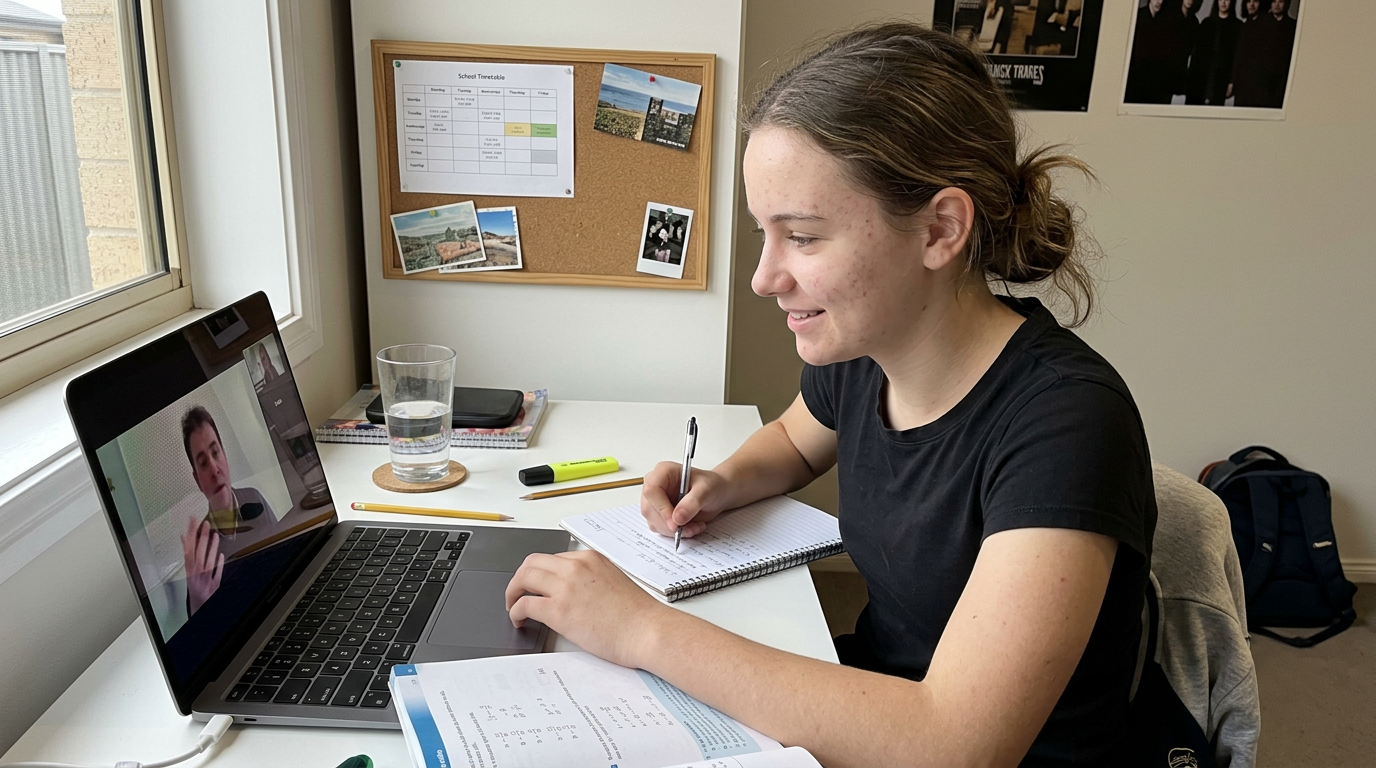
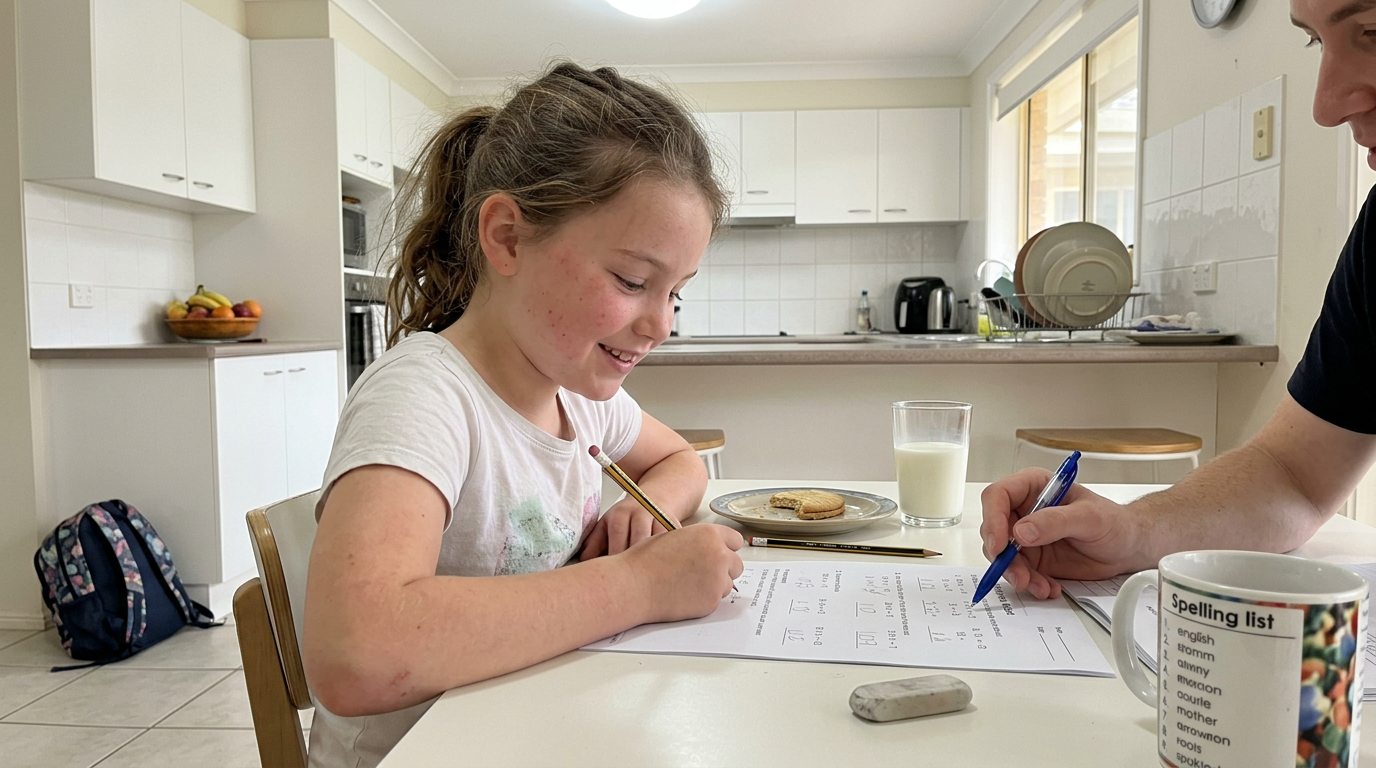
The differences come down to medium, logistics, tutor pool and tools. In-person tutoring means a tutor sits next to your child at your kitchen table, dining room or a tutoring centre, with paper, pencils and physical textbooks. Online tutoring means your child connects to a tutor via a laptop or tablet at a scheduled time, working together on a shared digital whiteboard with their textbook either on-screen or open beside them.
The day-to-day differences for parents are concrete. With in-person, you're locked into a specific tutor in your suburb (or a small radius), you pay a travel surcharge in most cases, sessions are vulnerable to traffic and cancellations, and you need a quiet room ready for the tutor to work in. With online, your child can connect from anywhere with Wi-Fi, you can choose a tutor from anywhere in Australia, sessions are easier to reschedule, and the digital whiteboard means the tutor can see exactly where your child is stuck in real time.
The structural difference matters most: in-person tutoring is paper-based and ephemeral (whatever you wrote in the session is what you have), while online tutoring at a good provider is platform-based and recorded — the working stays accessible, progress is tracked, and parents get visibility they typically don't get with a private in-home tutor. Online tutoring also differs from local marketplace tutors in how the tutor is matched and supported.
Is online tutoring as good as in-person tutoring?
Yes — for Years 3 to 12, online tutoring is at least as good as in-person, and frequently better. The Education Endowment Foundation's review of one-to-one tuition found the format effect (online vs face-to-face) is small compared to the effect of tutor quality, lesson structure, and frequency. What matters is whether sessions are weekly, whether they're tied to your child's school work, and whether the tutor can identify and close specific knowledge gaps. All three are easier to maintain online than in-person.
The historical worry — "screens can't replicate sitting next to someone" — has not held up in our data. Across thousands of weekly Tutero sessions, we see equivalent or stronger gains for online students, particularly in maths, English and science. Three reasons: digital-native students concentrate well on screens, the digital whiteboard is more interactive than a notebook, and parents get progress visibility that's hard to get with a private in-home tutor.
The exception is young children with no screen-time discipline yet. For a Year 1 or Year 2 child who can't sit still for 30 minutes on a video call, in-person is genuinely better — at least until screen attention develops. Whether online tutoring is worth the investment depends mostly on the provider's structure, not the format itself.
Is online tutoring cheaper than in-person tutoring in Australia?
Yes. Typical online tutoring in Australia costs A$55–A$85/hour, while in-person home tutoring runs A$70–A$110/hour — the gap is the tutor's travel time and petrol, which an online provider doesn't pay for. Tutero charges A$65/hour for any year level, primary through senior, with no travel surcharge.
The hourly rate isn't the whole picture. With in-person tutoring you also pay (directly or indirectly) for the tutor's transit time — a 60-minute lesson often becomes a 90-minute commitment for the tutor, and that's priced in. Cancellations also cost more in-person: if the tutor is sick or stuck in traffic, the session is gone. Online providers typically offer easier rescheduling and substitute tutors when needed.
For a clear like-for-like cost comparison across formats, see our full guide to maths tutoring costs in Australia. The short version: online is cheaper per hour, more reliable per dollar, and easier to scale up or pause as your child's needs change across the school year. If you're also weighing lesson size rather than just delivery mode, our guide to group vs one-to-one tutoring covers when each is worth it.
Which is more flexible — online or in-person tutoring?
Online tutoring is dramatically more flexible. Sessions can be scheduled in 30-minute or 60-minute blocks at almost any time, including weeknights after dinner, weekends, school holidays, and even from a holiday house if your child needs continuity through the December–January summer. There's no driving, no traffic delay, no "the tutor's stuck on the M1" cancellation.
In-person tutoring, by contrast, is bounded by your tutor's travel radius and your evening schedule. A Year 7 child with Tuesday-night swim training and Thursday-night band practice may have only one realistic in-person tutoring window per week — and if their tutor is also booked on that night, you wait. Online opens the calendar wide.
Flexibility also matters for short-burst exam prep. Heading into ATAR trials, NAPLAN week or VCE SACs, families often want to add a second weekly session for 4–6 weeks. That's hard to arrange in-person (the tutor's other clients fill the diary); easy online (different tutor available, same platform, progress notes carry across).
Is online tutoring effective for primary school children?
Yes — for Years 3 to 6 specifically, online tutoring works well, often better than parents expect. By Year 3 most Australian children have enough screen attention to sit through a 30-minute or 45-minute one-to-one lesson, and the interactive whiteboard tools (drawing shapes, dragging counters, colouring fractions) are more engaging than a paper worksheet for many primary children.
Three rules of thumb make online primary tutoring work. First, keep sessions to 30–45 minutes — primary attention spans are shorter, and online is the same. Second, sit with your child for the first 1–2 sessions while they get comfortable with the platform; after that they can run it themselves. Third, set up a quiet, distraction-free spot — the kitchen table works fine if siblings are elsewhere, otherwise a bedroom desk.
Where online struggles for primary is Years K–2. A Foundation, Year 1 or Year 2 child usually doesn't have the screen attention to focus through a tutoring session unless a parent sits next to them the whole time — and at that point you may as well do the teaching yourself or hire an in-person tutor. The ideal time to begin tutoring for most families is Year 3 onwards, and that's also where online starts winning.
What's better for senior exam prep — online or in-person?
For ATAR, VCE, HSC, WACE, QCE and SACE preparation, online tutoring is the stronger choice for almost every senior student. The reasons compound at the senior end: specialist subject tutors (Specialist Maths, Chemistry, Legal Studies) are scarce in any one suburb but plentiful nationally; past papers and marking guides live online anyway; the digital whiteboard handles complex working better than a paper notebook; and senior students can fit lessons around school, sport and study schedules without the parent driving them anywhere.
For VCE and HSC subjects in particular, the ability to share a past-paper question on screen, work through it together with the tutor's annotations live, and save the marked-up version for revision is a genuine advantage online has over paper. Tutero senior students sit alongside thousands of other ATAR-bound peers in our system, so the tutor can benchmark a student's progress against the cohort and prioritise the topics that move the ATAR most.
The one situation where in-person still wins for seniors: a student who's specifically requested it, usually because they've had a great in-person tutor before and want continuity. Don't override that preference — the rapport is doing the work. Otherwise, default to online for VCE/HSC maths, English, sciences and humanities.
How does online tutoring work compared to face-to-face?
A typical Tutero online lesson runs for 30, 45 or 60 minutes on a shared digital whiteboard. Your child logs in, the tutor joins by video, and the two of them work side-by-side on the same on-screen page — drawing, typing, dragging objects, writing equations. The tutor can see your child's work in real time, point at exactly the line where they're stuck, and write next to their working without taking the pen out of their hand.
The structural rhythm is similar to in-person. Most lessons start with a quick check on what's been covered at school that week, move into either targeted homework help or a curriculum-aligned lesson on the next concept, and end with a short summary. The differences are technical, not pedagogical: the working stays in a digital file the student can revisit, the tutor's notes go to the parent automatically, and the next tutor (if a substitute is needed) can pick up exactly where the last one finished.
Compared to face-to-face, the shape of the lesson is the same. What's different is the visibility around the lesson — parents see what was covered, schools see progress data if you choose to share it, and the student can rewatch the working between sessions.
Are online tutors qualified the same as in-person tutors?
Yes — and at the higher-quality providers, online tutors are usually more rigorously vetted than the average local in-person tutor. An in-home private tutor found through a marketplace is typically self-listed: they upload a profile, set their own rate, and start taking bookings, often without any platform-side check on their actual teaching ability. Online tutoring providers that operate at scale (Tutero among them) screen for subject mastery, teaching ability, and Working with Children Check status before any tutor takes a session.
What to ask any tutor — online or in-person — before committing: do they have a current Working with Children Check, what's their qualification in the subject, how do they handle a student who's two years behind, and how do they communicate progress to parents. Tutero's tutors are all university students or graduates with strong subject backgrounds, screened for teaching ability, and supported by a platform that tracks every session. More on our tutors here.
The format itself doesn't determine qualification. A great in-person tutor and a great online tutor look the same on paper — the difference is in the screening process and the support around the tutor, both of which favour structured online providers over standalone in-person operators.
Can a tutor build rapport with a child online?
Yes, and faster than most parents expect. Rapport in tutoring isn't about physical proximity — it's about being seen, listened to, and not judged when you get something wrong. A skilled online tutor uses voice, eye contact through the camera, active listening and follow-up questions to build trust just as effectively as an in-person tutor. Often more effectively, because the digital whiteboard gives the tutor a constant shared focus to work on, which keeps the conversation flowing.
Some students actually open up faster online than in-person. The slight buffer of the screen makes it easier for a shy or anxious student to ask "I don't get this" without the embarrassment of asking it face-to-face. We've seen this pattern repeatedly with students who've previously hated tutoring — they engage better when the dynamic feels more like a study session and less like an adult-in-the-house lesson.
The exception is very young children, who often need the physical presence of an adult to stay focused. For a Year K, Year 1 or Year 2 child, in-person rapport develops faster simply because the tutor can sit close, hand them a pencil, and physically redirect attention. By Year 3 the rapport advantage flips back to either format equally.
When should I choose in-person tutoring over online?
Choose in-person tutoring in three specific situations. First, if your child is in Years K–2 and doesn't yet have the screen attention to focus through a tutoring session — sit them with an in-person tutor for now and revisit online from Year 3 onwards. Second, if your child has significant attention, behavioural or learning support needs that benefit from physical presence (an autism or ADHD diagnosis where face-to-face is part of the support plan, for example). Third, if your child specifically prefers in-person and has the rapport with a tutor they trust — don't override that preference for marginal cost savings.
Outside those three cases, the answer for almost every Australian family from Year 3 to Year 12 is: try online first. It's cheaper, more flexible, and produces equivalent or better outcomes. If your child genuinely doesn't engage with online after 4–6 sessions, switch to in-person — but in our experience this is rare.
The "we've always done in-person and it works" argument is fine if it works. It's not a reason to default new families away from online — the format hasn't been the bottleneck for most students for at least five years.
Which option is right for my child?
Match the format to your child's profile. Below is the practical recommendation by year level and situation:
- Years K–2 (Foundation to Year 2): In-person tutoring at the kitchen table, with a parent visible nearby. Screen attention isn't reliable yet.
- Years 3–6 (primary): Online tutoring. Sessions in 30–45 minute blocks, parent helps set up the platform for the first session or two, then steps back.
- Years 7–10 (lower-secondary): Online tutoring. Specialist subject access matters more from this point and online widens the tutor pool dramatically. Weekly 60-minute sessions are typical.
- Years 11–12 (senior, ATAR-bound): Online tutoring. Past-paper work, marking guides, and benchmarking against thousands of other ATAR students all favour the digital format.
- Children with significant learning support needs (autism, ADHD, dyslexia where face-to-face is part of the plan): In-person tutoring as the default; consider online as a supplement once routines are established.
- Regional or remote families: Online tutoring, always — the in-person tutor pool is too thin in most non-metro postcodes to find a good match locally.
If you're unsure, the cheap experiment is to try a Tutero session. Four weekly online lessons is enough to know whether the format works for your child, and we'll move them to a different tutor if it doesn't.
So which is better — online or in-person tutoring?
For Australian families with children in Years 3 to 12, online tutoring is the better default. It costs less, gives you access to a national tutor pool (including specialist senior-subject tutors), is dramatically easier to schedule around school and sport, and produces equivalent or better outcomes when the provider is structured properly. In-person tutoring keeps a real role for very young children and students with specific learning support needs — but for the majority of school-aged Australian children, online is the format that works best in 2026.
The format isn't the question that decides whether tutoring works. The question that decides whether tutoring works is whether the tutor can identify and close your child's specific knowledge gaps, week by week, without you having to project-manage it. That's about the system around the tutor, not whether the tutor is sitting next to your child or visible on a laptop.
Ready to see how online tutoring works for your child? Book a diagnostic session with Tutero and we'll match your child to a specialist tutor for their year level and subject. A$65/hour, no contracts, weekly progress reports — and you can switch tutors or pause anytime.
For most Australian families with children in Years 3 to 12, online tutoring is the better default. In-person keeps a real role for Years K–2 and students with specific learning support needs.
For most Australian families with children in Years 3 to 12, online tutoring is the better default. In-person keeps a real role for Years K–2 and students with specific learning support needs.
If your child is falling behind in maths or staring down NAPLAN, ATAR or VCE/HSC exams, the next question is usually a logistical one: should the tutor come to your kitchen table, or should the lessons run over a laptop? Online tutoring has matured fast since 2020 — the gap between the two formats today is narrower than most parents think, and in some cases online wins outright on cost, flexibility and tutor quality.
This guide compares online tutoring and in-person tutoring on every dimension Australian parents actually care about: cost, flexibility, learning outcomes, exam prep, primary-school suitability, tutor qualifications and rapport. We've worked with thousands of Year 1 to Year 12 families across Australia at Tutero, and the patterns are clear enough to make a confident recommendation by year level and situation.
Quick answer
For most Australian families with children in Years 3 to 12, online tutoring is the better choice. It's typically cheaper (no tutor travel surcharge), far more flexible to schedule, gives you access to specialist tutors regardless of postcode, and — crucially — produces equivalent or better learning outcomes when the platform is built for live one-to-one teaching. In-person tutoring is genuinely better in two specific cases: very young children (Years K–2) who struggle to focus on a screen, and students with significant attention or behavioural needs who benefit from physical presence. Everyone else: start online, switch to in-person only if your child specifically asks for it.
What are the differences between online and in-person tutoring?
The differences come down to medium, logistics, tutor pool and tools. In-person tutoring means a tutor sits next to your child at your kitchen table, dining room or a tutoring centre, with paper, pencils and physical textbooks. Online tutoring means your child connects to a tutor via a laptop or tablet at a scheduled time, working together on a shared digital whiteboard with their textbook either on-screen or open beside them.
The day-to-day differences for parents are concrete. With in-person, you're locked into a specific tutor in your suburb (or a small radius), you pay a travel surcharge in most cases, sessions are vulnerable to traffic and cancellations, and you need a quiet room ready for the tutor to work in. With online, your child can connect from anywhere with Wi-Fi, you can choose a tutor from anywhere in Australia, sessions are easier to reschedule, and the digital whiteboard means the tutor can see exactly where your child is stuck in real time.
The structural difference matters most: in-person tutoring is paper-based and ephemeral (whatever you wrote in the session is what you have), while online tutoring at a good provider is platform-based and recorded — the working stays accessible, progress is tracked, and parents get visibility they typically don't get with a private in-home tutor. Online tutoring also differs from local marketplace tutors in how the tutor is matched and supported.
Is online tutoring as good as in-person tutoring?
Yes — for Years 3 to 12, online tutoring is at least as good as in-person, and frequently better. The Education Endowment Foundation's review of one-to-one tuition found the format effect (online vs face-to-face) is small compared to the effect of tutor quality, lesson structure, and frequency. What matters is whether sessions are weekly, whether they're tied to your child's school work, and whether the tutor can identify and close specific knowledge gaps. All three are easier to maintain online than in-person.
The historical worry — "screens can't replicate sitting next to someone" — has not held up in our data. Across thousands of weekly Tutero sessions, we see equivalent or stronger gains for online students, particularly in maths, English and science. Three reasons: digital-native students concentrate well on screens, the digital whiteboard is more interactive than a notebook, and parents get progress visibility that's hard to get with a private in-home tutor.
The exception is young children with no screen-time discipline yet. For a Year 1 or Year 2 child who can't sit still for 30 minutes on a video call, in-person is genuinely better — at least until screen attention develops. Whether online tutoring is worth the investment depends mostly on the provider's structure, not the format itself.
Is online tutoring cheaper than in-person tutoring in Australia?
Yes. Typical online tutoring in Australia costs A$55–A$85/hour, while in-person home tutoring runs A$70–A$110/hour — the gap is the tutor's travel time and petrol, which an online provider doesn't pay for. Tutero charges A$65/hour for any year level, primary through senior, with no travel surcharge.
The hourly rate isn't the whole picture. With in-person tutoring you also pay (directly or indirectly) for the tutor's transit time — a 60-minute lesson often becomes a 90-minute commitment for the tutor, and that's priced in. Cancellations also cost more in-person: if the tutor is sick or stuck in traffic, the session is gone. Online providers typically offer easier rescheduling and substitute tutors when needed.
For a clear like-for-like cost comparison across formats, see our full guide to maths tutoring costs in Australia. The short version: online is cheaper per hour, more reliable per dollar, and easier to scale up or pause as your child's needs change across the school year. If you're also weighing lesson size rather than just delivery mode, our guide to group vs one-to-one tutoring covers when each is worth it.
Which is more flexible — online or in-person tutoring?
Online tutoring is dramatically more flexible. Sessions can be scheduled in 30-minute or 60-minute blocks at almost any time, including weeknights after dinner, weekends, school holidays, and even from a holiday house if your child needs continuity through the December–January summer. There's no driving, no traffic delay, no "the tutor's stuck on the M1" cancellation.
In-person tutoring, by contrast, is bounded by your tutor's travel radius and your evening schedule. A Year 7 child with Tuesday-night swim training and Thursday-night band practice may have only one realistic in-person tutoring window per week — and if their tutor is also booked on that night, you wait. Online opens the calendar wide.
Flexibility also matters for short-burst exam prep. Heading into ATAR trials, NAPLAN week or VCE SACs, families often want to add a second weekly session for 4–6 weeks. That's hard to arrange in-person (the tutor's other clients fill the diary); easy online (different tutor available, same platform, progress notes carry across).
Is online tutoring effective for primary school children?
Yes — for Years 3 to 6 specifically, online tutoring works well, often better than parents expect. By Year 3 most Australian children have enough screen attention to sit through a 30-minute or 45-minute one-to-one lesson, and the interactive whiteboard tools (drawing shapes, dragging counters, colouring fractions) are more engaging than a paper worksheet for many primary children.
Three rules of thumb make online primary tutoring work. First, keep sessions to 30–45 minutes — primary attention spans are shorter, and online is the same. Second, sit with your child for the first 1–2 sessions while they get comfortable with the platform; after that they can run it themselves. Third, set up a quiet, distraction-free spot — the kitchen table works fine if siblings are elsewhere, otherwise a bedroom desk.
Where online struggles for primary is Years K–2. A Foundation, Year 1 or Year 2 child usually doesn't have the screen attention to focus through a tutoring session unless a parent sits next to them the whole time — and at that point you may as well do the teaching yourself or hire an in-person tutor. The ideal time to begin tutoring for most families is Year 3 onwards, and that's also where online starts winning.
What's better for senior exam prep — online or in-person?
For ATAR, VCE, HSC, WACE, QCE and SACE preparation, online tutoring is the stronger choice for almost every senior student. The reasons compound at the senior end: specialist subject tutors (Specialist Maths, Chemistry, Legal Studies) are scarce in any one suburb but plentiful nationally; past papers and marking guides live online anyway; the digital whiteboard handles complex working better than a paper notebook; and senior students can fit lessons around school, sport and study schedules without the parent driving them anywhere.
For VCE and HSC subjects in particular, the ability to share a past-paper question on screen, work through it together with the tutor's annotations live, and save the marked-up version for revision is a genuine advantage online has over paper. Tutero senior students sit alongside thousands of other ATAR-bound peers in our system, so the tutor can benchmark a student's progress against the cohort and prioritise the topics that move the ATAR most.
The one situation where in-person still wins for seniors: a student who's specifically requested it, usually because they've had a great in-person tutor before and want continuity. Don't override that preference — the rapport is doing the work. Otherwise, default to online for VCE/HSC maths, English, sciences and humanities.
How does online tutoring work compared to face-to-face?
A typical Tutero online lesson runs for 30, 45 or 60 minutes on a shared digital whiteboard. Your child logs in, the tutor joins by video, and the two of them work side-by-side on the same on-screen page — drawing, typing, dragging objects, writing equations. The tutor can see your child's work in real time, point at exactly the line where they're stuck, and write next to their working without taking the pen out of their hand.
The structural rhythm is similar to in-person. Most lessons start with a quick check on what's been covered at school that week, move into either targeted homework help or a curriculum-aligned lesson on the next concept, and end with a short summary. The differences are technical, not pedagogical: the working stays in a digital file the student can revisit, the tutor's notes go to the parent automatically, and the next tutor (if a substitute is needed) can pick up exactly where the last one finished.
Compared to face-to-face, the shape of the lesson is the same. What's different is the visibility around the lesson — parents see what was covered, schools see progress data if you choose to share it, and the student can rewatch the working between sessions.
Are online tutors qualified the same as in-person tutors?
Yes — and at the higher-quality providers, online tutors are usually more rigorously vetted than the average local in-person tutor. An in-home private tutor found through a marketplace is typically self-listed: they upload a profile, set their own rate, and start taking bookings, often without any platform-side check on their actual teaching ability. Online tutoring providers that operate at scale (Tutero among them) screen for subject mastery, teaching ability, and Working with Children Check status before any tutor takes a session.
What to ask any tutor — online or in-person — before committing: do they have a current Working with Children Check, what's their qualification in the subject, how do they handle a student who's two years behind, and how do they communicate progress to parents. Tutero's tutors are all university students or graduates with strong subject backgrounds, screened for teaching ability, and supported by a platform that tracks every session. More on our tutors here.
The format itself doesn't determine qualification. A great in-person tutor and a great online tutor look the same on paper — the difference is in the screening process and the support around the tutor, both of which favour structured online providers over standalone in-person operators.
Can a tutor build rapport with a child online?
Yes, and faster than most parents expect. Rapport in tutoring isn't about physical proximity — it's about being seen, listened to, and not judged when you get something wrong. A skilled online tutor uses voice, eye contact through the camera, active listening and follow-up questions to build trust just as effectively as an in-person tutor. Often more effectively, because the digital whiteboard gives the tutor a constant shared focus to work on, which keeps the conversation flowing.
Some students actually open up faster online than in-person. The slight buffer of the screen makes it easier for a shy or anxious student to ask "I don't get this" without the embarrassment of asking it face-to-face. We've seen this pattern repeatedly with students who've previously hated tutoring — they engage better when the dynamic feels more like a study session and less like an adult-in-the-house lesson.
The exception is very young children, who often need the physical presence of an adult to stay focused. For a Year K, Year 1 or Year 2 child, in-person rapport develops faster simply because the tutor can sit close, hand them a pencil, and physically redirect attention. By Year 3 the rapport advantage flips back to either format equally.
When should I choose in-person tutoring over online?
Choose in-person tutoring in three specific situations. First, if your child is in Years K–2 and doesn't yet have the screen attention to focus through a tutoring session — sit them with an in-person tutor for now and revisit online from Year 3 onwards. Second, if your child has significant attention, behavioural or learning support needs that benefit from physical presence (an autism or ADHD diagnosis where face-to-face is part of the support plan, for example). Third, if your child specifically prefers in-person and has the rapport with a tutor they trust — don't override that preference for marginal cost savings.
Outside those three cases, the answer for almost every Australian family from Year 3 to Year 12 is: try online first. It's cheaper, more flexible, and produces equivalent or better outcomes. If your child genuinely doesn't engage with online after 4–6 sessions, switch to in-person — but in our experience this is rare.
The "we've always done in-person and it works" argument is fine if it works. It's not a reason to default new families away from online — the format hasn't been the bottleneck for most students for at least five years.
Which option is right for my child?
Match the format to your child's profile. Below is the practical recommendation by year level and situation:
- Years K–2 (Foundation to Year 2): In-person tutoring at the kitchen table, with a parent visible nearby. Screen attention isn't reliable yet.
- Years 3–6 (primary): Online tutoring. Sessions in 30–45 minute blocks, parent helps set up the platform for the first session or two, then steps back.
- Years 7–10 (lower-secondary): Online tutoring. Specialist subject access matters more from this point and online widens the tutor pool dramatically. Weekly 60-minute sessions are typical.
- Years 11–12 (senior, ATAR-bound): Online tutoring. Past-paper work, marking guides, and benchmarking against thousands of other ATAR students all favour the digital format.
- Children with significant learning support needs (autism, ADHD, dyslexia where face-to-face is part of the plan): In-person tutoring as the default; consider online as a supplement once routines are established.
- Regional or remote families: Online tutoring, always — the in-person tutor pool is too thin in most non-metro postcodes to find a good match locally.
If you're unsure, the cheap experiment is to try a Tutero session. Four weekly online lessons is enough to know whether the format works for your child, and we'll move them to a different tutor if it doesn't.
So which is better — online or in-person tutoring?
For Australian families with children in Years 3 to 12, online tutoring is the better default. It costs less, gives you access to a national tutor pool (including specialist senior-subject tutors), is dramatically easier to schedule around school and sport, and produces equivalent or better outcomes when the provider is structured properly. In-person tutoring keeps a real role for very young children and students with specific learning support needs — but for the majority of school-aged Australian children, online is the format that works best in 2026.
The format isn't the question that decides whether tutoring works. The question that decides whether tutoring works is whether the tutor can identify and close your child's specific knowledge gaps, week by week, without you having to project-manage it. That's about the system around the tutor, not whether the tutor is sitting next to your child or visible on a laptop.
Ready to see how online tutoring works for your child? Book a diagnostic session with Tutero and we'll match your child to a specialist tutor for their year level and subject. A$65/hour, no contracts, weekly progress reports — and you can switch tutors or pause anytime.
For most Australian families with children in Years 3 to 12, online tutoring is the better default. In-person keeps a real role for Years K–2 and students with specific learning support needs.
For most Australian families with children in Years 3 to 12, online tutoring is the better default. In-person keeps a real role for Years K–2 and students with specific learning support needs.

For most Australian families with children in Years 3 to 12, online tutoring is the better default. In-person keeps a real role for Years K–2 and students with specific learning support needs.
Rapport isn't about physical proximity — it's about being seen, listened to, and not judged when you get something wrong. A skilled online tutor builds that just as effectively as an in-person one.
If your child is falling behind in maths or staring down NAPLAN, ATAR or VCE/HSC exams, the next question is usually a logistical one: should the tutor come to your kitchen table, or should the lessons run over a laptop? Online tutoring has matured fast since 2020 — the gap between the two formats today is narrower than most parents think, and in some cases online wins outright on cost, flexibility and tutor quality.
This guide compares online tutoring and in-person tutoring on every dimension Australian parents actually care about: cost, flexibility, learning outcomes, exam prep, primary-school suitability, tutor qualifications and rapport. We've worked with thousands of Year 1 to Year 12 families across Australia at Tutero, and the patterns are clear enough to make a confident recommendation by year level and situation.
Quick answer
For most Australian families with children in Years 3 to 12, online tutoring is the better choice. It's typically cheaper (no tutor travel surcharge), far more flexible to schedule, gives you access to specialist tutors regardless of postcode, and — crucially — produces equivalent or better learning outcomes when the platform is built for live one-to-one teaching. In-person tutoring is genuinely better in two specific cases: very young children (Years K–2) who struggle to focus on a screen, and students with significant attention or behavioural needs who benefit from physical presence. Everyone else: start online, switch to in-person only if your child specifically asks for it.
What are the differences between online and in-person tutoring?
The differences come down to medium, logistics, tutor pool and tools. In-person tutoring means a tutor sits next to your child at your kitchen table, dining room or a tutoring centre, with paper, pencils and physical textbooks. Online tutoring means your child connects to a tutor via a laptop or tablet at a scheduled time, working together on a shared digital whiteboard with their textbook either on-screen or open beside them.
The day-to-day differences for parents are concrete. With in-person, you're locked into a specific tutor in your suburb (or a small radius), you pay a travel surcharge in most cases, sessions are vulnerable to traffic and cancellations, and you need a quiet room ready for the tutor to work in. With online, your child can connect from anywhere with Wi-Fi, you can choose a tutor from anywhere in Australia, sessions are easier to reschedule, and the digital whiteboard means the tutor can see exactly where your child is stuck in real time.
The structural difference matters most: in-person tutoring is paper-based and ephemeral (whatever you wrote in the session is what you have), while online tutoring at a good provider is platform-based and recorded — the working stays accessible, progress is tracked, and parents get visibility they typically don't get with a private in-home tutor. Online tutoring also differs from local marketplace tutors in how the tutor is matched and supported.
Is online tutoring as good as in-person tutoring?
Yes — for Years 3 to 12, online tutoring is at least as good as in-person, and frequently better. The Education Endowment Foundation's review of one-to-one tuition found the format effect (online vs face-to-face) is small compared to the effect of tutor quality, lesson structure, and frequency. What matters is whether sessions are weekly, whether they're tied to your child's school work, and whether the tutor can identify and close specific knowledge gaps. All three are easier to maintain online than in-person.
The historical worry — "screens can't replicate sitting next to someone" — has not held up in our data. Across thousands of weekly Tutero sessions, we see equivalent or stronger gains for online students, particularly in maths, English and science. Three reasons: digital-native students concentrate well on screens, the digital whiteboard is more interactive than a notebook, and parents get progress visibility that's hard to get with a private in-home tutor.
The exception is young children with no screen-time discipline yet. For a Year 1 or Year 2 child who can't sit still for 30 minutes on a video call, in-person is genuinely better — at least until screen attention develops. Whether online tutoring is worth the investment depends mostly on the provider's structure, not the format itself.
Is online tutoring cheaper than in-person tutoring in Australia?
Yes. Typical online tutoring in Australia costs A$55–A$85/hour, while in-person home tutoring runs A$70–A$110/hour — the gap is the tutor's travel time and petrol, which an online provider doesn't pay for. Tutero charges A$65/hour for any year level, primary through senior, with no travel surcharge.
The hourly rate isn't the whole picture. With in-person tutoring you also pay (directly or indirectly) for the tutor's transit time — a 60-minute lesson often becomes a 90-minute commitment for the tutor, and that's priced in. Cancellations also cost more in-person: if the tutor is sick or stuck in traffic, the session is gone. Online providers typically offer easier rescheduling and substitute tutors when needed.
For a clear like-for-like cost comparison across formats, see our full guide to maths tutoring costs in Australia. The short version: online is cheaper per hour, more reliable per dollar, and easier to scale up or pause as your child's needs change across the school year. If you're also weighing lesson size rather than just delivery mode, our guide to group vs one-to-one tutoring covers when each is worth it.
Which is more flexible — online or in-person tutoring?
Online tutoring is dramatically more flexible. Sessions can be scheduled in 30-minute or 60-minute blocks at almost any time, including weeknights after dinner, weekends, school holidays, and even from a holiday house if your child needs continuity through the December–January summer. There's no driving, no traffic delay, no "the tutor's stuck on the M1" cancellation.
In-person tutoring, by contrast, is bounded by your tutor's travel radius and your evening schedule. A Year 7 child with Tuesday-night swim training and Thursday-night band practice may have only one realistic in-person tutoring window per week — and if their tutor is also booked on that night, you wait. Online opens the calendar wide.
Flexibility also matters for short-burst exam prep. Heading into ATAR trials, NAPLAN week or VCE SACs, families often want to add a second weekly session for 4–6 weeks. That's hard to arrange in-person (the tutor's other clients fill the diary); easy online (different tutor available, same platform, progress notes carry across).
Is online tutoring effective for primary school children?
Yes — for Years 3 to 6 specifically, online tutoring works well, often better than parents expect. By Year 3 most Australian children have enough screen attention to sit through a 30-minute or 45-minute one-to-one lesson, and the interactive whiteboard tools (drawing shapes, dragging counters, colouring fractions) are more engaging than a paper worksheet for many primary children.
Three rules of thumb make online primary tutoring work. First, keep sessions to 30–45 minutes — primary attention spans are shorter, and online is the same. Second, sit with your child for the first 1–2 sessions while they get comfortable with the platform; after that they can run it themselves. Third, set up a quiet, distraction-free spot — the kitchen table works fine if siblings are elsewhere, otherwise a bedroom desk.
Where online struggles for primary is Years K–2. A Foundation, Year 1 or Year 2 child usually doesn't have the screen attention to focus through a tutoring session unless a parent sits next to them the whole time — and at that point you may as well do the teaching yourself or hire an in-person tutor. The ideal time to begin tutoring for most families is Year 3 onwards, and that's also where online starts winning.
What's better for senior exam prep — online or in-person?
For ATAR, VCE, HSC, WACE, QCE and SACE preparation, online tutoring is the stronger choice for almost every senior student. The reasons compound at the senior end: specialist subject tutors (Specialist Maths, Chemistry, Legal Studies) are scarce in any one suburb but plentiful nationally; past papers and marking guides live online anyway; the digital whiteboard handles complex working better than a paper notebook; and senior students can fit lessons around school, sport and study schedules without the parent driving them anywhere.
For VCE and HSC subjects in particular, the ability to share a past-paper question on screen, work through it together with the tutor's annotations live, and save the marked-up version for revision is a genuine advantage online has over paper. Tutero senior students sit alongside thousands of other ATAR-bound peers in our system, so the tutor can benchmark a student's progress against the cohort and prioritise the topics that move the ATAR most.
The one situation where in-person still wins for seniors: a student who's specifically requested it, usually because they've had a great in-person tutor before and want continuity. Don't override that preference — the rapport is doing the work. Otherwise, default to online for VCE/HSC maths, English, sciences and humanities.
How does online tutoring work compared to face-to-face?
A typical Tutero online lesson runs for 30, 45 or 60 minutes on a shared digital whiteboard. Your child logs in, the tutor joins by video, and the two of them work side-by-side on the same on-screen page — drawing, typing, dragging objects, writing equations. The tutor can see your child's work in real time, point at exactly the line where they're stuck, and write next to their working without taking the pen out of their hand.
The structural rhythm is similar to in-person. Most lessons start with a quick check on what's been covered at school that week, move into either targeted homework help or a curriculum-aligned lesson on the next concept, and end with a short summary. The differences are technical, not pedagogical: the working stays in a digital file the student can revisit, the tutor's notes go to the parent automatically, and the next tutor (if a substitute is needed) can pick up exactly where the last one finished.
Compared to face-to-face, the shape of the lesson is the same. What's different is the visibility around the lesson — parents see what was covered, schools see progress data if you choose to share it, and the student can rewatch the working between sessions.
Are online tutors qualified the same as in-person tutors?
Yes — and at the higher-quality providers, online tutors are usually more rigorously vetted than the average local in-person tutor. An in-home private tutor found through a marketplace is typically self-listed: they upload a profile, set their own rate, and start taking bookings, often without any platform-side check on their actual teaching ability. Online tutoring providers that operate at scale (Tutero among them) screen for subject mastery, teaching ability, and Working with Children Check status before any tutor takes a session.
What to ask any tutor — online or in-person — before committing: do they have a current Working with Children Check, what's their qualification in the subject, how do they handle a student who's two years behind, and how do they communicate progress to parents. Tutero's tutors are all university students or graduates with strong subject backgrounds, screened for teaching ability, and supported by a platform that tracks every session. More on our tutors here.
The format itself doesn't determine qualification. A great in-person tutor and a great online tutor look the same on paper — the difference is in the screening process and the support around the tutor, both of which favour structured online providers over standalone in-person operators.
Can a tutor build rapport with a child online?
Yes, and faster than most parents expect. Rapport in tutoring isn't about physical proximity — it's about being seen, listened to, and not judged when you get something wrong. A skilled online tutor uses voice, eye contact through the camera, active listening and follow-up questions to build trust just as effectively as an in-person tutor. Often more effectively, because the digital whiteboard gives the tutor a constant shared focus to work on, which keeps the conversation flowing.
Some students actually open up faster online than in-person. The slight buffer of the screen makes it easier for a shy or anxious student to ask "I don't get this" without the embarrassment of asking it face-to-face. We've seen this pattern repeatedly with students who've previously hated tutoring — they engage better when the dynamic feels more like a study session and less like an adult-in-the-house lesson.
The exception is very young children, who often need the physical presence of an adult to stay focused. For a Year K, Year 1 or Year 2 child, in-person rapport develops faster simply because the tutor can sit close, hand them a pencil, and physically redirect attention. By Year 3 the rapport advantage flips back to either format equally.
When should I choose in-person tutoring over online?
Choose in-person tutoring in three specific situations. First, if your child is in Years K–2 and doesn't yet have the screen attention to focus through a tutoring session — sit them with an in-person tutor for now and revisit online from Year 3 onwards. Second, if your child has significant attention, behavioural or learning support needs that benefit from physical presence (an autism or ADHD diagnosis where face-to-face is part of the support plan, for example). Third, if your child specifically prefers in-person and has the rapport with a tutor they trust — don't override that preference for marginal cost savings.
Outside those three cases, the answer for almost every Australian family from Year 3 to Year 12 is: try online first. It's cheaper, more flexible, and produces equivalent or better outcomes. If your child genuinely doesn't engage with online after 4–6 sessions, switch to in-person — but in our experience this is rare.
The "we've always done in-person and it works" argument is fine if it works. It's not a reason to default new families away from online — the format hasn't been the bottleneck for most students for at least five years.
Which option is right for my child?
Match the format to your child's profile. Below is the practical recommendation by year level and situation:
- Years K–2 (Foundation to Year 2): In-person tutoring at the kitchen table, with a parent visible nearby. Screen attention isn't reliable yet.
- Years 3–6 (primary): Online tutoring. Sessions in 30–45 minute blocks, parent helps set up the platform for the first session or two, then steps back.
- Years 7–10 (lower-secondary): Online tutoring. Specialist subject access matters more from this point and online widens the tutor pool dramatically. Weekly 60-minute sessions are typical.
- Years 11–12 (senior, ATAR-bound): Online tutoring. Past-paper work, marking guides, and benchmarking against thousands of other ATAR students all favour the digital format.
- Children with significant learning support needs (autism, ADHD, dyslexia where face-to-face is part of the plan): In-person tutoring as the default; consider online as a supplement once routines are established.
- Regional or remote families: Online tutoring, always — the in-person tutor pool is too thin in most non-metro postcodes to find a good match locally.
If you're unsure, the cheap experiment is to try a Tutero session. Four weekly online lessons is enough to know whether the format works for your child, and we'll move them to a different tutor if it doesn't.
So which is better — online or in-person tutoring?
For Australian families with children in Years 3 to 12, online tutoring is the better default. It costs less, gives you access to a national tutor pool (including specialist senior-subject tutors), is dramatically easier to schedule around school and sport, and produces equivalent or better outcomes when the provider is structured properly. In-person tutoring keeps a real role for very young children and students with specific learning support needs — but for the majority of school-aged Australian children, online is the format that works best in 2026.
The format isn't the question that decides whether tutoring works. The question that decides whether tutoring works is whether the tutor can identify and close your child's specific knowledge gaps, week by week, without you having to project-manage it. That's about the system around the tutor, not whether the tutor is sitting next to your child or visible on a laptop.
Ready to see how online tutoring works for your child? Book a diagnostic session with Tutero and we'll match your child to a specialist tutor for their year level and subject. A$65/hour, no contracts, weekly progress reports — and you can switch tutors or pause anytime.
For most Australian families with children in Years 3 to 12, online tutoring is the better default. In-person keeps a real role for Years K–2 and students with specific learning support needs.
Rapport isn't about physical proximity — it's about being seen, listened to, and not judged when you get something wrong. A skilled online tutor builds that just as effectively as an in-person one.
.svg)
.svg)
Yes — for Years 3 to 12, online tutoring is at least as good as in-person, and frequently better. Tutor quality and lesson structure matter more than the format. Years K–2 students often do better with in-person until screen attention develops.
Online tutoring in Australia typically costs A$55–A$85/hour vs A$70–A$110/hour for in-person home tutoring — the gap is the tutor's travel time. Tutero charges A$65/hour for any year level with no travel surcharge.
Online tutoring is dramatically more flexible. Sessions schedule into 30 or 60-minute blocks at almost any time, including weeknights, weekends and school holidays. In-person tutoring is bounded by the tutor's travel radius and your evening schedule.
Yes, from Year 3 onwards. By Year 3 most Australian children have enough screen attention for a 30–45 minute one-to-one lesson. Years K–2 children usually need in-person until screen-time discipline develops.
Online tutoring wins for senior exam prep in almost every case. Specialist subject tutors are scarce locally but plentiful nationally, past papers live online anyway, and the digital whiteboard handles complex working better than paper.
Choose in-person if your child is in Years K–2 and doesn't yet have the screen attention to focus through a session, or if they have significant attention or learning support needs that benefit from physical presence, or if they specifically prefer in-person and have rapport with a trusted tutor.
Hoping to improve confidence & grades?

.png)


