.svg)

If you remind your child four times to put their dishes in the sink, you're not raising a careless kid — you're carrying a load they haven't been taught to pick up yet. Responsibility isn't a personality trait children are born with; it's a stack of small skills that parents scaffold over years.
This guide gives you the scaffold. The age-by-age chore list, the homework-ownership shift, the allowance question, the "stop nagging" routine, and the cleanest way to teach a teenager to be responsible without sliding into a fight every Sunday night.
Quick answer
You teach a child to be responsible by handing them ownership of one small thing at a time, scaffolding it for a few weeks, then stepping back. Start with age-appropriate chores (a 4-year-old can put toys away; a 10-year-old can pack their own school bag; a 14-year-old can manage their own homework calendar). Pair each new responsibility with a clear job description, a fixed time of day, and a visible result the child can see. Praise effort, name natural consequences when they slip, and resist the urge to do it for them. The research from the University of Minnesota (Marty Rossmann) found children who started chores at age 3–4 were significantly more likely to be successful adults than children who didn't start until their teens. Responsibility compounds. Start small, start early, and stay out of the way.
How do I teach my child to be more responsible?
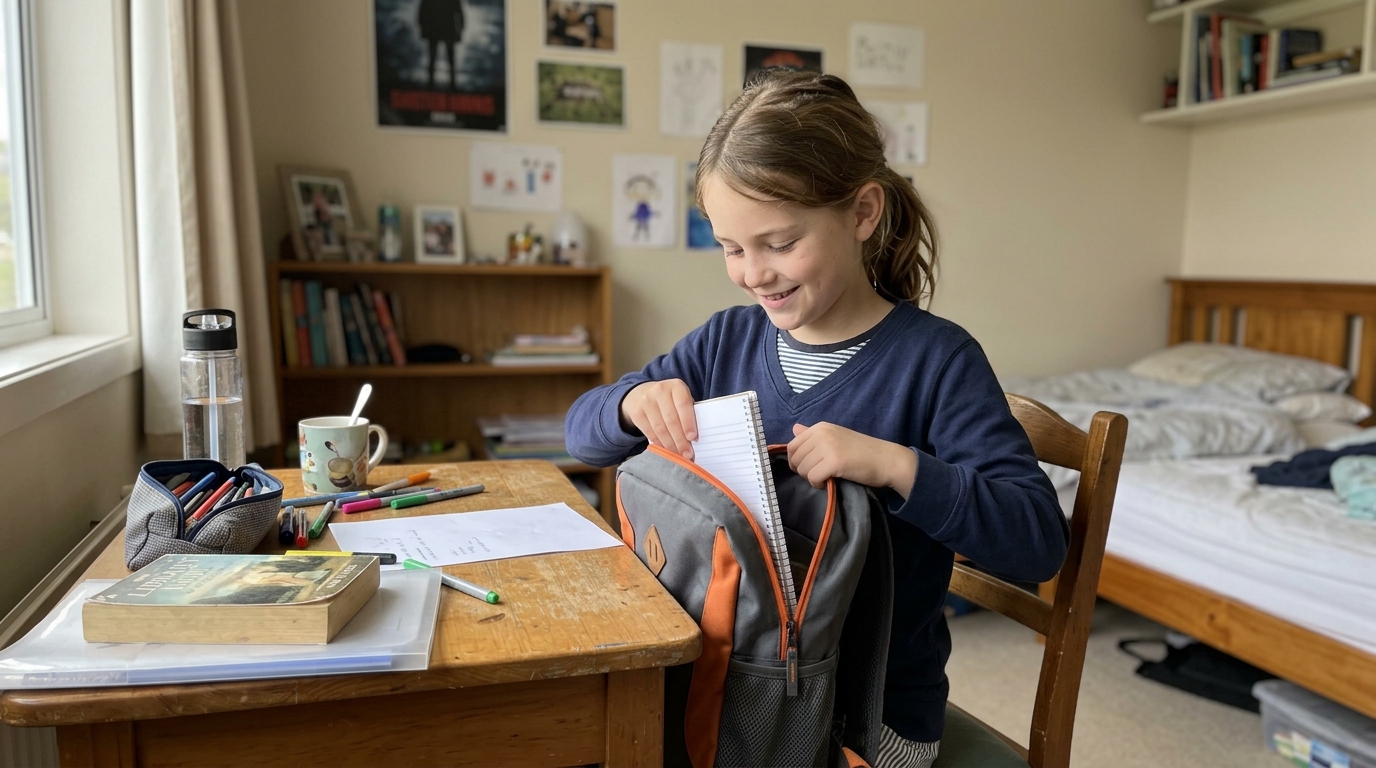
The mechanic is the same at every age: hand over one small task, scaffold it, then step back. You can't teach responsibility in the abstract. You teach it by giving the child a specific, visible job — feeding the dog, packing tomorrow's lunch, taking the bins out — and letting them feel both the small success when they nail it and the small natural consequence when they don't. The biggest mistake parents make is rescuing too early; if you do the task for them after they forget, you've taught them that forgetting works.
Self-Determination Theory, the body of work pioneered by psychologists Edward Deci and Richard Ryan, frames the same idea differently: children develop intrinsic motivation when they experience autonomy, competence, and relatedness. Responsibility lives at the intersection. The job has to feel like theirs (autonomy), they have to be capable of doing it well (competence), and they have to know it matters to the family (relatedness). Wendy Grolnick's research on autonomy-supportive parenting at Clark University adds the practical layer: parents who acknowledge the child's perspective ("I know it's annoying having to do this before screen time") and explain the reason ("the dog needs to eat at the same time every day") raise more responsible children than parents who command without context.
Practically, that turns into five moves: pick the task, explain why it matters, scaffold it for two to three weeks, name the consequence when they forget, and then stop reminding. A child who is reminded forever never learns to remember.
What chores should kids be doing by age?
The American Academy of Pediatrics and decades of family-engagement research land on roughly the same age bands. The point isn't the specific chore — it's that every age has a "next rung" that fits. Pick one or two, hold them steady for a month, and only then add another.
| Age | Reasonable chores | What you're really teaching |
|---|---|---|
| 3–4 years | Putting toys back in the box, feeding the pet with a pre-measured cup, putting their plate on the bench | Things have a place. I can put them there. |
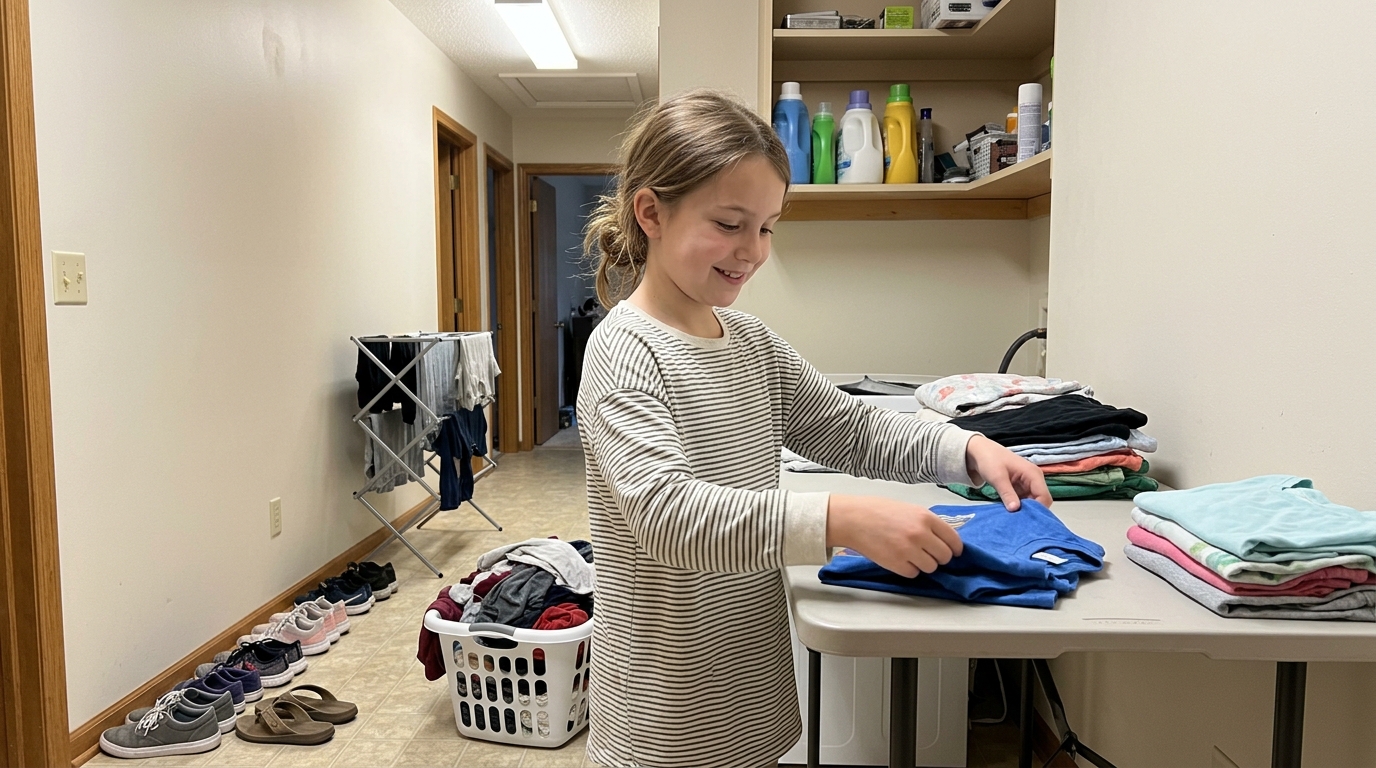
| 5–7 years | Setting the table, making their bed, sorting laundry into colors, watering plants | My contribution matters. The family runs on small jobs. |
| 8–10 years | Packing their own schoolbag, taking bins out, vacuuming one room, helping with dinner prep | I'm responsible for my own things, and I can hold a recurring schedule. |
| 11–13 years | Doing their own laundry, cooking one simple meal a week, looking after a younger sibling for short stretches, managing their homework calendar | I can plan a multi-step task. I notice when something needs doing. |
| 14+ years | Running the laundry cycle solo, managing their own paper planner or digital calendar, budgeting a small allowance, organizing their own school commitments | I run my own systems. My parents are coaches, not operators. |
The rule of thumb: if the child can physically do it and emotionally tolerate doing it, they're old enough to own it. Most parents underestimate what their child can handle, then overcorrect at 15 when the gap shows up.
How do I get my kids to take responsibility for homework?
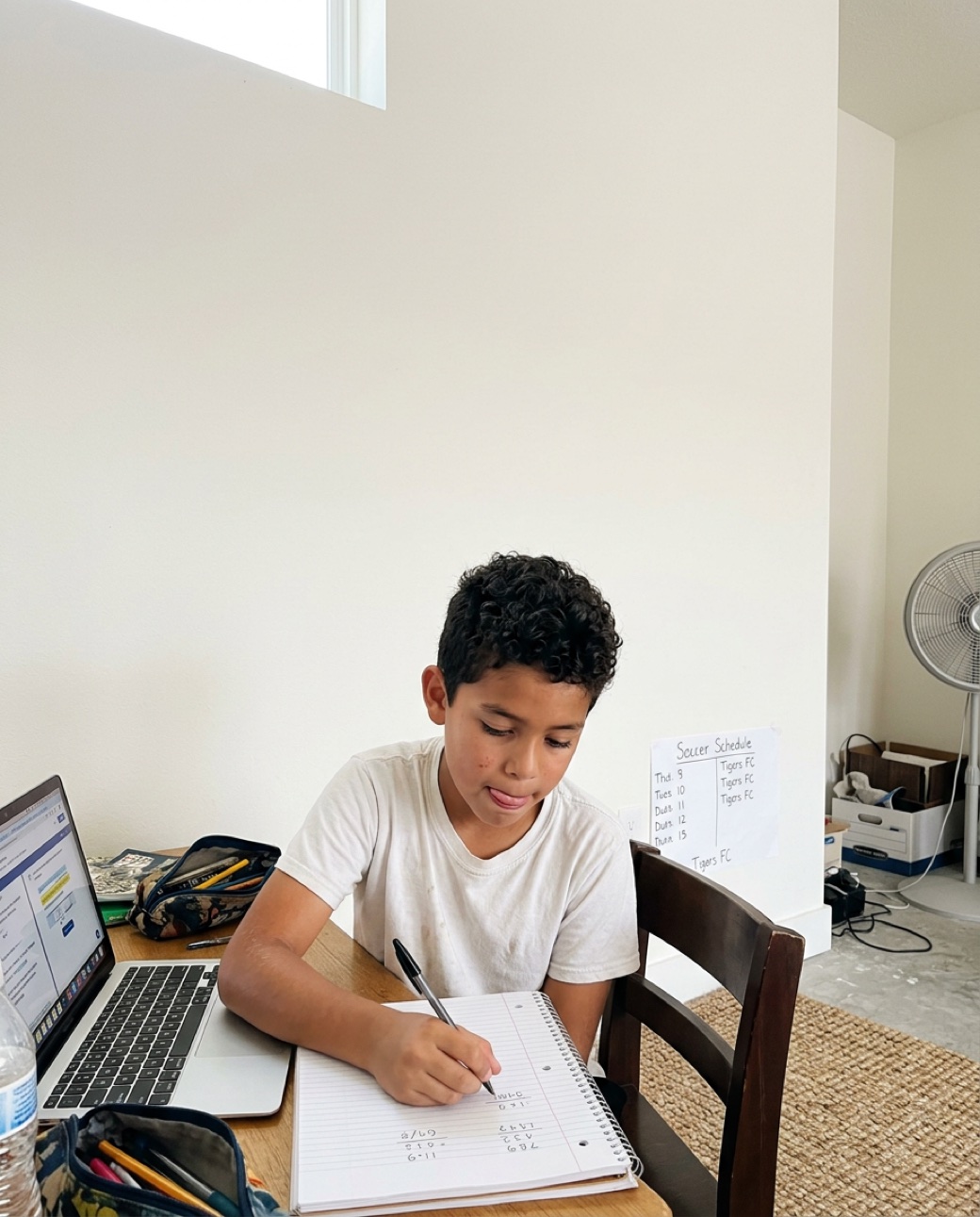
Homework is the single biggest responsibility battlefield in most families because it sits at the intersection of school stakes and parent anxiety. The shortest path: own the system, not the work. You're not there to write the answers, check every line, or sit beside them for an hour. You're there to set up the conditions — same desk, same time, no phone, no TV — and then leave the room.
Three concrete moves work across elementary and high school:
- Fixed time, fixed place. Homework happens at the same desk at the same time every weekday. The child doesn't decide whether to do it; they decide what to start with. For grade 3–6 students, 20–40 minutes is plenty. For grade 7–10, 60–90 minutes. For grade 11–12, the child should be planning their own blocks by now.
- The two-question check-in. Once a week, ask "What's due this week, and what's the hardest piece?" — not every night. Daily interrogation breeds resentment and outsources the worry from the child to you. A weekly check-in keeps you informed without taking the wheel.
- Let them feel one missed deadline. If they forget a task, don't email the teacher. Let them turn up empty-handed once. The natural consequence — the brief embarrassment, the conversation with the teacher — does more for responsibility than any reminder you could give.
If your child is genuinely stuck on the content (not the routine), bringing in a tutor for two or three sessions can reset the relationship between your child and the work. A good tutor coaches them through the task without taking over. Tutero pairs students one-to-one with tutors from US$45/hr; sessions are weekly, online, and built around the child's actual school content. See how online tutoring works if homework battles are becoming a daily fight.
Should kids get an allowance for chores?
The honest answer is "it depends on what you're trying to teach." Most family researchers and the American Academy of Pediatrics land in the same place: tie an allowance to responsibility for money, not to doing chores. Chores are a contribution to the family — everyone does them because they live in the house. An allowance is a teaching tool for the separate skill of managing money.
The cleanest version of the model:
- Baseline chores are unpaid. Making the bed, putting dishes in the sink, packing the schoolbag — these are part of being in the family.
- The allowance is small, regular, and not contingent on those chores. US$5–US$15 a week from age 7–8 onwards, scaling with age. Pay it on the same day every week.
- Bonus jobs can be paid. Washing the car, weeding the front garden, cleaning the oven — one-off jobs above the baseline are fine to pay for. This teaches the child that effort outside their normal role earns money.
- Three-jar split. When the allowance lands, the child splits it three ways: spend, save, give. The split teaches that money has more than one job. By age 12 or 13 most children can handle a simple bank account and start tracking it themselves.
The mistake to avoid: paying for the daily baseline. The moment the child realises they can opt out of making their bed by skipping the dollar, you've turned a family contribution into a transaction. Once that frame is set it's hard to unwind.
How do I stop nagging my child about responsibilities?
Nagging is the symptom that the system has collapsed back onto you. You stop nagging by replacing reminders with structures, and by letting natural consequences land. Reminders teach the child that you'll remember for them. Structures teach the child to remember themselves.
Three structural swaps that do most of the work:
- Visible job lists, not verbal reminders. A whiteboard on the fridge with three things they own that day ("schoolbag packed", "lunchbox emptied", "homework done") replaces ten verbal reminders. Children check off what they've done. You check the board, not the child.
- One warning, then the consequence. If the rule is "schoolbag packed before screen time", say it once. If they reach for the iPad before the bag is packed, the iPad goes back, no debate. Repeated warnings train the child that the consequence is negotiable.
- Acknowledge the friction, then hold the line. Wendy Grolnick's research is clear: "I know it's annoying to do this when you'd rather be on the couch — and the dog still needs feeding before dinner" works better than either pure command ("just do it") or pure permissiveness ("fine, I'll feed her"). Acknowledge, then hold.
The hard part isn't designing the system. It's not nagging when the system runs. The first two weeks of any new structure feel worse than nagging because the child tests the limit. By week three or four the structure runs itself and the household becomes noticeably calmer.
What's the difference between teaching responsibility and overloading a child?
The line is real and parents who ignore it raise either anxious over-functioning kids or kids who give up. Responsibility is appropriate, scaffolded ownership; overload is asking a child to manage adult-sized stakes without adult-sized capacity. Three signs you've crossed the line, in increasing severity:
- Sleep, mood, or appetite shifts. A child carrying too much will show it in their body before they show it in their words. Trouble falling asleep, withdrawing socially, irritability that's out of character, or a sudden dip in appetite are early signs the load is too high.
- The child is managing a sibling's care, a parent's emotions, or family logistics. Looking after a younger sibling for an hour after school is fine; being the de-facto carer is not. Being the family's emotional pressure-release valve is not a job a child should hold.
- The child can't fail safely. Responsibility teaches the child to recover from a small mistake — they forget the bag once, they remember next time. Overload removes the safety net: the test they failed costs them a place at the school they wanted, the budget they overspent leaves the family short, the chore they skipped means a sibling didn't eat.
The fix is the same in all three cases: pull the responsibility back, make the rung smaller, and rebuild from a level the child can actually hold. There's no medal for handing a child responsibility before they can carry it.
How do I teach a teenager to be more responsible?
By age 13–14 the parent-as-operator model is over. Your job shifts from doing-with to coaching. Teenagers learn responsibility by holding ownership of bigger systems — their study calendar, their social commitments, their phone use, their part-time job, their sleep — and by experiencing real consequences when they drop one.
The five-move teenage shift:
- Hand over the calendar. By 8th grade, the teenager owns a paper planner or digital calendar that tracks their assignments, sport, work, and social commitments. You stop being their reminder system.
- Tie privileges to the system, not to chores. Driving lessons, weekend social plans, later bedtimes — these are linked to the teenager running their own life: assignments handed in on time, room reasonably clean, family dinner attended. Not to a chore checklist.
- Let them work. A part-time job from age 14–15 (cafe, tutoring younger kids, retail) teaches more about responsibility than any conversation. Pay schedules, shift cover, customer service — there's no parental scaffolding equivalent.
- Discuss money openly. By 15 or 16 a teenager should know roughly what household bills cost, what their phone plan costs, and what they earn per hour. Vague money talk produces vague money habits.
- Coach the recovery, not the failure. When a teenager fails — a failed test, a lost shift, a friend they hurt — the conversation isn't "what did you do wrong" but "what's your move from here". Adults who can recover from setbacks are made by parents who let teenagers fail and then coached them through the recovery.
When should my child start managing their own time?
Time-management is a stack of skills that builds across elementary, middle, and high school years. The earliest meaningful time-management starts around age 7–8 with a visible weekly routine; it matures into full self-management by grade 11–12. The age bands are:
- Grades K–3 (ages 5–9). The child runs morning and evening routines from a visible chart — get dressed, breakfast, teeth, bag at the door. They're not managing time yet; they're following a sequence. Parents read the time and call the next step.
- Grades 4–5 (ages 10–11). The child starts reading the clock for their own routines — "be ready to leave at 8:15", "homework done by 5:30". They begin to feel the difference between 20 minutes and an hour. This is the right age to introduce a visible weekly homework block.
- Grades 6–8 (ages 12–14). The child runs their own homework calendar. They know what's due Friday by Wednesday. They start scheduling their own study before tests rather than the night before. Parents review the plan once a week, not nightly.
- Grades 9–12 (ages 15–18). The student plans multi-week revision blocks, manages their own assessment calendar, and arranges their own tutoring or study sessions. By the start of senior year, parents shouldn't be checking the calendar at all.
The fastest way to short-circuit this stack is to keep doing the time-management for them. Children whose parents pack their bag, set their alarm, and remind them about every assignment arrive in junior year with no infrastructure for self-management — and the high-stakes year is the worst possible time to learn it.
Where does tutoring fit into building responsibility?
Tutoring isn't a responsibility-builder by itself, but a good tutor reinforces the scaffold parents are already running. The right tutor coaches the child through the work without taking over, asks the kind of "what's your move from here" questions parents struggle to ask without it sounding like a quiz, and gives the child a weekly accountability point that isn't their parent.
Tutero pairs students one-to-one with experienced tutors from US$45/hr — same rate across elementary, middle, and high school. Sessions are weekly, online, and built around the child's actual school content. We don't run group classes or generic worksheets; the tutor reads the child's school feedback and shapes the session around it. Parents tell us the biggest unexpected benefit is what happens between sessions: the child starts owning their week because they know the tutor is going to ask. See how online tutoring works at Tutero, or meet some of our tutors to find one who matches your child.
So how do I actually teach my child to be more responsible?
The work is small, repeated, and slow. Pick one rung — packing the schoolbag, feeding the dog, taking the bins out, owning the homework block. Scaffold it for two to three weeks. Step back. Add the next rung when the first one runs without reminders. Acknowledge the friction, hold the line, and trust the natural consequences when they slip.
Children who are taught responsibility this way arrive at adulthood as people who can run their own lives — not because they were told to be responsible, but because they were given a thousand small chances to feel what responsibility actually feels like, and the time to build the muscle. Start with the smallest rung you can find this week. By the end of the semester, you'll be reminding them less.
Ready to bring in a one-to-one tutor who reinforces the scaffold without taking over?
See how Tutero's online tutoring works, or read our guide to self-directed learning at home and our tips for setting academic goals for the matching parent playbooks.
A child who is reminded forever never learns to remember.
A child who is reminded forever never learns to remember.
If you remind your child four times to put their dishes in the sink, you're not raising a careless kid — you're carrying a load they haven't been taught to pick up yet. Responsibility isn't a personality trait children are born with; it's a stack of small skills that parents scaffold over years.
This guide gives you the scaffold. The age-by-age chore list, the homework-ownership shift, the allowance question, the "stop nagging" routine, and the cleanest way to teach a teenager to be responsible without sliding into a fight every Sunday night.
Quick answer
You teach a child to be responsible by handing them ownership of one small thing at a time, scaffolding it for a few weeks, then stepping back. Start with age-appropriate chores (a 4-year-old can put toys away; a 10-year-old can pack their own school bag; a 14-year-old can manage their own homework calendar). Pair each new responsibility with a clear job description, a fixed time of day, and a visible result the child can see. Praise effort, name natural consequences when they slip, and resist the urge to do it for them. The research from the University of Minnesota (Marty Rossmann) found children who started chores at age 3–4 were significantly more likely to be successful adults than children who didn't start until their teens. Responsibility compounds. Start small, start early, and stay out of the way.
How do I teach my child to be more responsible?
The mechanic is the same at every age: hand over one small task, scaffold it, then step back. You can't teach responsibility in the abstract. You teach it by giving the child a specific, visible job — feeding the dog, packing tomorrow's lunch, taking the bins out — and letting them feel both the small success when they nail it and the small natural consequence when they don't. The biggest mistake parents make is rescuing too early; if you do the task for them after they forget, you've taught them that forgetting works.
Self-Determination Theory, the body of work pioneered by psychologists Edward Deci and Richard Ryan, frames the same idea differently: children develop intrinsic motivation when they experience autonomy, competence, and relatedness. Responsibility lives at the intersection. The job has to feel like theirs (autonomy), they have to be capable of doing it well (competence), and they have to know it matters to the family (relatedness). Wendy Grolnick's research on autonomy-supportive parenting at Clark University adds the practical layer: parents who acknowledge the child's perspective ("I know it's annoying having to do this before screen time") and explain the reason ("the dog needs to eat at the same time every day") raise more responsible children than parents who command without context.
Practically, that turns into five moves: pick the task, explain why it matters, scaffold it for two to three weeks, name the consequence when they forget, and then stop reminding. A child who is reminded forever never learns to remember.
What chores should kids be doing by age?
The American Academy of Pediatrics and decades of family-engagement research land on roughly the same age bands. The point isn't the specific chore — it's that every age has a "next rung" that fits. Pick one or two, hold them steady for a month, and only then add another.
| Age | Reasonable chores | What you're really teaching |
|---|---|---|
| 3–4 years | Putting toys back in the box, feeding the pet with a pre-measured cup, putting their plate on the bench | Things have a place. I can put them there. |
| 5–7 years | Setting the table, making their bed, sorting laundry into colors, watering plants | My contribution matters. The family runs on small jobs. |
| 8–10 years | Packing their own schoolbag, taking bins out, vacuuming one room, helping with dinner prep | I'm responsible for my own things, and I can hold a recurring schedule. |
| 11–13 years | Doing their own laundry, cooking one simple meal a week, looking after a younger sibling for short stretches, managing their homework calendar | I can plan a multi-step task. I notice when something needs doing. |
| 14+ years | Running the laundry cycle solo, managing their own paper planner or digital calendar, budgeting a small allowance, organizing their own school commitments | I run my own systems. My parents are coaches, not operators. |
The rule of thumb: if the child can physically do it and emotionally tolerate doing it, they're old enough to own it. Most parents underestimate what their child can handle, then overcorrect at 15 when the gap shows up.
How do I get my kids to take responsibility for homework?
Homework is the single biggest responsibility battlefield in most families because it sits at the intersection of school stakes and parent anxiety. The shortest path: own the system, not the work. You're not there to write the answers, check every line, or sit beside them for an hour. You're there to set up the conditions — same desk, same time, no phone, no TV — and then leave the room.
Three concrete moves work across elementary and high school:
- Fixed time, fixed place. Homework happens at the same desk at the same time every weekday. The child doesn't decide whether to do it; they decide what to start with. For grade 3–6 students, 20–40 minutes is plenty. For grade 7–10, 60–90 minutes. For grade 11–12, the child should be planning their own blocks by now.
- The two-question check-in. Once a week, ask "What's due this week, and what's the hardest piece?" — not every night. Daily interrogation breeds resentment and outsources the worry from the child to you. A weekly check-in keeps you informed without taking the wheel.
- Let them feel one missed deadline. If they forget a task, don't email the teacher. Let them turn up empty-handed once. The natural consequence — the brief embarrassment, the conversation with the teacher — does more for responsibility than any reminder you could give.
If your child is genuinely stuck on the content (not the routine), bringing in a tutor for two or three sessions can reset the relationship between your child and the work. A good tutor coaches them through the task without taking over. Tutero pairs students one-to-one with tutors from US$45/hr; sessions are weekly, online, and built around the child's actual school content. See how online tutoring works if homework battles are becoming a daily fight.
Should kids get an allowance for chores?
The honest answer is "it depends on what you're trying to teach." Most family researchers and the American Academy of Pediatrics land in the same place: tie an allowance to responsibility for money, not to doing chores. Chores are a contribution to the family — everyone does them because they live in the house. An allowance is a teaching tool for the separate skill of managing money.
The cleanest version of the model:
- Baseline chores are unpaid. Making the bed, putting dishes in the sink, packing the schoolbag — these are part of being in the family.
- The allowance is small, regular, and not contingent on those chores. US$5–US$15 a week from age 7–8 onwards, scaling with age. Pay it on the same day every week.
- Bonus jobs can be paid. Washing the car, weeding the front garden, cleaning the oven — one-off jobs above the baseline are fine to pay for. This teaches the child that effort outside their normal role earns money.
- Three-jar split. When the allowance lands, the child splits it three ways: spend, save, give. The split teaches that money has more than one job. By age 12 or 13 most children can handle a simple bank account and start tracking it themselves.
The mistake to avoid: paying for the daily baseline. The moment the child realises they can opt out of making their bed by skipping the dollar, you've turned a family contribution into a transaction. Once that frame is set it's hard to unwind.
How do I stop nagging my child about responsibilities?
Nagging is the symptom that the system has collapsed back onto you. You stop nagging by replacing reminders with structures, and by letting natural consequences land. Reminders teach the child that you'll remember for them. Structures teach the child to remember themselves.
Three structural swaps that do most of the work:
- Visible job lists, not verbal reminders. A whiteboard on the fridge with three things they own that day ("schoolbag packed", "lunchbox emptied", "homework done") replaces ten verbal reminders. Children check off what they've done. You check the board, not the child.
- One warning, then the consequence. If the rule is "schoolbag packed before screen time", say it once. If they reach for the iPad before the bag is packed, the iPad goes back, no debate. Repeated warnings train the child that the consequence is negotiable.
- Acknowledge the friction, then hold the line. Wendy Grolnick's research is clear: "I know it's annoying to do this when you'd rather be on the couch — and the dog still needs feeding before dinner" works better than either pure command ("just do it") or pure permissiveness ("fine, I'll feed her"). Acknowledge, then hold.
The hard part isn't designing the system. It's not nagging when the system runs. The first two weeks of any new structure feel worse than nagging because the child tests the limit. By week three or four the structure runs itself and the household becomes noticeably calmer.
What's the difference between teaching responsibility and overloading a child?
The line is real and parents who ignore it raise either anxious over-functioning kids or kids who give up. Responsibility is appropriate, scaffolded ownership; overload is asking a child to manage adult-sized stakes without adult-sized capacity. Three signs you've crossed the line, in increasing severity:
- Sleep, mood, or appetite shifts. A child carrying too much will show it in their body before they show it in their words. Trouble falling asleep, withdrawing socially, irritability that's out of character, or a sudden dip in appetite are early signs the load is too high.
- The child is managing a sibling's care, a parent's emotions, or family logistics. Looking after a younger sibling for an hour after school is fine; being the de-facto carer is not. Being the family's emotional pressure-release valve is not a job a child should hold.
- The child can't fail safely. Responsibility teaches the child to recover from a small mistake — they forget the bag once, they remember next time. Overload removes the safety net: the test they failed costs them a place at the school they wanted, the budget they overspent leaves the family short, the chore they skipped means a sibling didn't eat.
The fix is the same in all three cases: pull the responsibility back, make the rung smaller, and rebuild from a level the child can actually hold. There's no medal for handing a child responsibility before they can carry it.
How do I teach a teenager to be more responsible?
By age 13–14 the parent-as-operator model is over. Your job shifts from doing-with to coaching. Teenagers learn responsibility by holding ownership of bigger systems — their study calendar, their social commitments, their phone use, their part-time job, their sleep — and by experiencing real consequences when they drop one.
The five-move teenage shift:
- Hand over the calendar. By 8th grade, the teenager owns a paper planner or digital calendar that tracks their assignments, sport, work, and social commitments. You stop being their reminder system.
- Tie privileges to the system, not to chores. Driving lessons, weekend social plans, later bedtimes — these are linked to the teenager running their own life: assignments handed in on time, room reasonably clean, family dinner attended. Not to a chore checklist.
- Let them work. A part-time job from age 14–15 (cafe, tutoring younger kids, retail) teaches more about responsibility than any conversation. Pay schedules, shift cover, customer service — there's no parental scaffolding equivalent.
- Discuss money openly. By 15 or 16 a teenager should know roughly what household bills cost, what their phone plan costs, and what they earn per hour. Vague money talk produces vague money habits.
- Coach the recovery, not the failure. When a teenager fails — a failed test, a lost shift, a friend they hurt — the conversation isn't "what did you do wrong" but "what's your move from here". Adults who can recover from setbacks are made by parents who let teenagers fail and then coached them through the recovery.
When should my child start managing their own time?
Time-management is a stack of skills that builds across elementary, middle, and high school years. The earliest meaningful time-management starts around age 7–8 with a visible weekly routine; it matures into full self-management by grade 11–12. The age bands are:
- Grades K–3 (ages 5–9). The child runs morning and evening routines from a visible chart — get dressed, breakfast, teeth, bag at the door. They're not managing time yet; they're following a sequence. Parents read the time and call the next step.
- Grades 4–5 (ages 10–11). The child starts reading the clock for their own routines — "be ready to leave at 8:15", "homework done by 5:30". They begin to feel the difference between 20 minutes and an hour. This is the right age to introduce a visible weekly homework block.
- Grades 6–8 (ages 12–14). The child runs their own homework calendar. They know what's due Friday by Wednesday. They start scheduling their own study before tests rather than the night before. Parents review the plan once a week, not nightly.
- Grades 9–12 (ages 15–18). The student plans multi-week revision blocks, manages their own assessment calendar, and arranges their own tutoring or study sessions. By the start of senior year, parents shouldn't be checking the calendar at all.
The fastest way to short-circuit this stack is to keep doing the time-management for them. Children whose parents pack their bag, set their alarm, and remind them about every assignment arrive in junior year with no infrastructure for self-management — and the high-stakes year is the worst possible time to learn it.
Where does tutoring fit into building responsibility?
Tutoring isn't a responsibility-builder by itself, but a good tutor reinforces the scaffold parents are already running. The right tutor coaches the child through the work without taking over, asks the kind of "what's your move from here" questions parents struggle to ask without it sounding like a quiz, and gives the child a weekly accountability point that isn't their parent.
Tutero pairs students one-to-one with experienced tutors from US$45/hr — same rate across elementary, middle, and high school. Sessions are weekly, online, and built around the child's actual school content. We don't run group classes or generic worksheets; the tutor reads the child's school feedback and shapes the session around it. Parents tell us the biggest unexpected benefit is what happens between sessions: the child starts owning their week because they know the tutor is going to ask. See how online tutoring works at Tutero, or meet some of our tutors to find one who matches your child.
So how do I actually teach my child to be more responsible?
The work is small, repeated, and slow. Pick one rung — packing the schoolbag, feeding the dog, taking the bins out, owning the homework block. Scaffold it for two to three weeks. Step back. Add the next rung when the first one runs without reminders. Acknowledge the friction, hold the line, and trust the natural consequences when they slip.
Children who are taught responsibility this way arrive at adulthood as people who can run their own lives — not because they were told to be responsible, but because they were given a thousand small chances to feel what responsibility actually feels like, and the time to build the muscle. Start with the smallest rung you can find this week. By the end of the semester, you'll be reminding them less.
Ready to bring in a one-to-one tutor who reinforces the scaffold without taking over?
See how Tutero's online tutoring works, or read our guide to self-directed learning at home and our tips for setting academic goals for the matching parent playbooks.
A child who is reminded forever never learns to remember.
A child who is reminded forever never learns to remember.

A child who is reminded forever never learns to remember.
Responsibility is built one small rung at a time. Hand it over, scaffold it, then step back.
If you remind your child four times to put their dishes in the sink, you're not raising a careless kid — you're carrying a load they haven't been taught to pick up yet. Responsibility isn't a personality trait children are born with; it's a stack of small skills that parents scaffold over years.
This guide gives you the scaffold. The age-by-age chore list, the homework-ownership shift, the allowance question, the "stop nagging" routine, and the cleanest way to teach a teenager to be responsible without sliding into a fight every Sunday night.
Quick answer
You teach a child to be responsible by handing them ownership of one small thing at a time, scaffolding it for a few weeks, then stepping back. Start with age-appropriate chores (a 4-year-old can put toys away; a 10-year-old can pack their own school bag; a 14-year-old can manage their own homework calendar). Pair each new responsibility with a clear job description, a fixed time of day, and a visible result the child can see. Praise effort, name natural consequences when they slip, and resist the urge to do it for them. The research from the University of Minnesota (Marty Rossmann) found children who started chores at age 3–4 were significantly more likely to be successful adults than children who didn't start until their teens. Responsibility compounds. Start small, start early, and stay out of the way.
How do I teach my child to be more responsible?
The mechanic is the same at every age: hand over one small task, scaffold it, then step back. You can't teach responsibility in the abstract. You teach it by giving the child a specific, visible job — feeding the dog, packing tomorrow's lunch, taking the bins out — and letting them feel both the small success when they nail it and the small natural consequence when they don't. The biggest mistake parents make is rescuing too early; if you do the task for them after they forget, you've taught them that forgetting works.
Self-Determination Theory, the body of work pioneered by psychologists Edward Deci and Richard Ryan, frames the same idea differently: children develop intrinsic motivation when they experience autonomy, competence, and relatedness. Responsibility lives at the intersection. The job has to feel like theirs (autonomy), they have to be capable of doing it well (competence), and they have to know it matters to the family (relatedness). Wendy Grolnick's research on autonomy-supportive parenting at Clark University adds the practical layer: parents who acknowledge the child's perspective ("I know it's annoying having to do this before screen time") and explain the reason ("the dog needs to eat at the same time every day") raise more responsible children than parents who command without context.
Practically, that turns into five moves: pick the task, explain why it matters, scaffold it for two to three weeks, name the consequence when they forget, and then stop reminding. A child who is reminded forever never learns to remember.
What chores should kids be doing by age?
The American Academy of Pediatrics and decades of family-engagement research land on roughly the same age bands. The point isn't the specific chore — it's that every age has a "next rung" that fits. Pick one or two, hold them steady for a month, and only then add another.
| Age | Reasonable chores | What you're really teaching |
|---|---|---|
| 3–4 years | Putting toys back in the box, feeding the pet with a pre-measured cup, putting their plate on the bench | Things have a place. I can put them there. |
| 5–7 years | Setting the table, making their bed, sorting laundry into colors, watering plants | My contribution matters. The family runs on small jobs. |
| 8–10 years | Packing their own schoolbag, taking bins out, vacuuming one room, helping with dinner prep | I'm responsible for my own things, and I can hold a recurring schedule. |
| 11–13 years | Doing their own laundry, cooking one simple meal a week, looking after a younger sibling for short stretches, managing their homework calendar | I can plan a multi-step task. I notice when something needs doing. |
| 14+ years | Running the laundry cycle solo, managing their own paper planner or digital calendar, budgeting a small allowance, organizing their own school commitments | I run my own systems. My parents are coaches, not operators. |
The rule of thumb: if the child can physically do it and emotionally tolerate doing it, they're old enough to own it. Most parents underestimate what their child can handle, then overcorrect at 15 when the gap shows up.
How do I get my kids to take responsibility for homework?
Homework is the single biggest responsibility battlefield in most families because it sits at the intersection of school stakes and parent anxiety. The shortest path: own the system, not the work. You're not there to write the answers, check every line, or sit beside them for an hour. You're there to set up the conditions — same desk, same time, no phone, no TV — and then leave the room.
Three concrete moves work across elementary and high school:
- Fixed time, fixed place. Homework happens at the same desk at the same time every weekday. The child doesn't decide whether to do it; they decide what to start with. For grade 3–6 students, 20–40 minutes is plenty. For grade 7–10, 60–90 minutes. For grade 11–12, the child should be planning their own blocks by now.
- The two-question check-in. Once a week, ask "What's due this week, and what's the hardest piece?" — not every night. Daily interrogation breeds resentment and outsources the worry from the child to you. A weekly check-in keeps you informed without taking the wheel.
- Let them feel one missed deadline. If they forget a task, don't email the teacher. Let them turn up empty-handed once. The natural consequence — the brief embarrassment, the conversation with the teacher — does more for responsibility than any reminder you could give.
If your child is genuinely stuck on the content (not the routine), bringing in a tutor for two or three sessions can reset the relationship between your child and the work. A good tutor coaches them through the task without taking over. Tutero pairs students one-to-one with tutors from US$45/hr; sessions are weekly, online, and built around the child's actual school content. See how online tutoring works if homework battles are becoming a daily fight.
Should kids get an allowance for chores?
The honest answer is "it depends on what you're trying to teach." Most family researchers and the American Academy of Pediatrics land in the same place: tie an allowance to responsibility for money, not to doing chores. Chores are a contribution to the family — everyone does them because they live in the house. An allowance is a teaching tool for the separate skill of managing money.
The cleanest version of the model:
- Baseline chores are unpaid. Making the bed, putting dishes in the sink, packing the schoolbag — these are part of being in the family.
- The allowance is small, regular, and not contingent on those chores. US$5–US$15 a week from age 7–8 onwards, scaling with age. Pay it on the same day every week.
- Bonus jobs can be paid. Washing the car, weeding the front garden, cleaning the oven — one-off jobs above the baseline are fine to pay for. This teaches the child that effort outside their normal role earns money.
- Three-jar split. When the allowance lands, the child splits it three ways: spend, save, give. The split teaches that money has more than one job. By age 12 or 13 most children can handle a simple bank account and start tracking it themselves.
The mistake to avoid: paying for the daily baseline. The moment the child realises they can opt out of making their bed by skipping the dollar, you've turned a family contribution into a transaction. Once that frame is set it's hard to unwind.
How do I stop nagging my child about responsibilities?
Nagging is the symptom that the system has collapsed back onto you. You stop nagging by replacing reminders with structures, and by letting natural consequences land. Reminders teach the child that you'll remember for them. Structures teach the child to remember themselves.
Three structural swaps that do most of the work:
- Visible job lists, not verbal reminders. A whiteboard on the fridge with three things they own that day ("schoolbag packed", "lunchbox emptied", "homework done") replaces ten verbal reminders. Children check off what they've done. You check the board, not the child.
- One warning, then the consequence. If the rule is "schoolbag packed before screen time", say it once. If they reach for the iPad before the bag is packed, the iPad goes back, no debate. Repeated warnings train the child that the consequence is negotiable.
- Acknowledge the friction, then hold the line. Wendy Grolnick's research is clear: "I know it's annoying to do this when you'd rather be on the couch — and the dog still needs feeding before dinner" works better than either pure command ("just do it") or pure permissiveness ("fine, I'll feed her"). Acknowledge, then hold.
The hard part isn't designing the system. It's not nagging when the system runs. The first two weeks of any new structure feel worse than nagging because the child tests the limit. By week three or four the structure runs itself and the household becomes noticeably calmer.
What's the difference between teaching responsibility and overloading a child?
The line is real and parents who ignore it raise either anxious over-functioning kids or kids who give up. Responsibility is appropriate, scaffolded ownership; overload is asking a child to manage adult-sized stakes without adult-sized capacity. Three signs you've crossed the line, in increasing severity:
- Sleep, mood, or appetite shifts. A child carrying too much will show it in their body before they show it in their words. Trouble falling asleep, withdrawing socially, irritability that's out of character, or a sudden dip in appetite are early signs the load is too high.
- The child is managing a sibling's care, a parent's emotions, or family logistics. Looking after a younger sibling for an hour after school is fine; being the de-facto carer is not. Being the family's emotional pressure-release valve is not a job a child should hold.
- The child can't fail safely. Responsibility teaches the child to recover from a small mistake — they forget the bag once, they remember next time. Overload removes the safety net: the test they failed costs them a place at the school they wanted, the budget they overspent leaves the family short, the chore they skipped means a sibling didn't eat.
The fix is the same in all three cases: pull the responsibility back, make the rung smaller, and rebuild from a level the child can actually hold. There's no medal for handing a child responsibility before they can carry it.
How do I teach a teenager to be more responsible?
By age 13–14 the parent-as-operator model is over. Your job shifts from doing-with to coaching. Teenagers learn responsibility by holding ownership of bigger systems — their study calendar, their social commitments, their phone use, their part-time job, their sleep — and by experiencing real consequences when they drop one.
The five-move teenage shift:
- Hand over the calendar. By 8th grade, the teenager owns a paper planner or digital calendar that tracks their assignments, sport, work, and social commitments. You stop being their reminder system.
- Tie privileges to the system, not to chores. Driving lessons, weekend social plans, later bedtimes — these are linked to the teenager running their own life: assignments handed in on time, room reasonably clean, family dinner attended. Not to a chore checklist.
- Let them work. A part-time job from age 14–15 (cafe, tutoring younger kids, retail) teaches more about responsibility than any conversation. Pay schedules, shift cover, customer service — there's no parental scaffolding equivalent.
- Discuss money openly. By 15 or 16 a teenager should know roughly what household bills cost, what their phone plan costs, and what they earn per hour. Vague money talk produces vague money habits.
- Coach the recovery, not the failure. When a teenager fails — a failed test, a lost shift, a friend they hurt — the conversation isn't "what did you do wrong" but "what's your move from here". Adults who can recover from setbacks are made by parents who let teenagers fail and then coached them through the recovery.
When should my child start managing their own time?
Time-management is a stack of skills that builds across elementary, middle, and high school years. The earliest meaningful time-management starts around age 7–8 with a visible weekly routine; it matures into full self-management by grade 11–12. The age bands are:
- Grades K–3 (ages 5–9). The child runs morning and evening routines from a visible chart — get dressed, breakfast, teeth, bag at the door. They're not managing time yet; they're following a sequence. Parents read the time and call the next step.
- Grades 4–5 (ages 10–11). The child starts reading the clock for their own routines — "be ready to leave at 8:15", "homework done by 5:30". They begin to feel the difference between 20 minutes and an hour. This is the right age to introduce a visible weekly homework block.
- Grades 6–8 (ages 12–14). The child runs their own homework calendar. They know what's due Friday by Wednesday. They start scheduling their own study before tests rather than the night before. Parents review the plan once a week, not nightly.
- Grades 9–12 (ages 15–18). The student plans multi-week revision blocks, manages their own assessment calendar, and arranges their own tutoring or study sessions. By the start of senior year, parents shouldn't be checking the calendar at all.
The fastest way to short-circuit this stack is to keep doing the time-management for them. Children whose parents pack their bag, set their alarm, and remind them about every assignment arrive in junior year with no infrastructure for self-management — and the high-stakes year is the worst possible time to learn it.
Where does tutoring fit into building responsibility?
Tutoring isn't a responsibility-builder by itself, but a good tutor reinforces the scaffold parents are already running. The right tutor coaches the child through the work without taking over, asks the kind of "what's your move from here" questions parents struggle to ask without it sounding like a quiz, and gives the child a weekly accountability point that isn't their parent.
Tutero pairs students one-to-one with experienced tutors from US$45/hr — same rate across elementary, middle, and high school. Sessions are weekly, online, and built around the child's actual school content. We don't run group classes or generic worksheets; the tutor reads the child's school feedback and shapes the session around it. Parents tell us the biggest unexpected benefit is what happens between sessions: the child starts owning their week because they know the tutor is going to ask. See how online tutoring works at Tutero, or meet some of our tutors to find one who matches your child.
So how do I actually teach my child to be more responsible?
The work is small, repeated, and slow. Pick one rung — packing the schoolbag, feeding the dog, taking the bins out, owning the homework block. Scaffold it for two to three weeks. Step back. Add the next rung when the first one runs without reminders. Acknowledge the friction, hold the line, and trust the natural consequences when they slip.
Children who are taught responsibility this way arrive at adulthood as people who can run their own lives — not because they were told to be responsible, but because they were given a thousand small chances to feel what responsibility actually feels like, and the time to build the muscle. Start with the smallest rung you can find this week. By the end of the semester, you'll be reminding them less.
Ready to bring in a one-to-one tutor who reinforces the scaffold without taking over?
See how Tutero's online tutoring works, or read our guide to self-directed learning at home and our tips for setting academic goals for the matching parent playbooks.
A child who is reminded forever never learns to remember.
Responsibility is built one small rung at a time. Hand it over, scaffold it, then step back.
.svg)
.svg)
Hand them ownership of one small task at a time, scaffold it for two to three weeks, then step back. Pair every new responsibility with a clear job description, a fixed time of day, and a visible result the child can see. Praise effort, name natural consequences when they slip, and resist the urge to do it for them. Responsibility is built one rung at a time.
Ages 3–4: putting toys away and feeding the pet. Ages 5–7: setting the table, making their bed, sorting laundry. Ages 8–10: packing their own backpack, taking out the trash, vacuuming a room. Ages 11–13: doing their own laundry, cooking a simple meal, managing their homework calendar. Age 14+: running the laundry cycle solo, managing their own planner, budgeting an allowance.
Tie an allowance to learning to manage money, not to doing chores. Baseline chores (making the bed, packing the backpack) are unpaid contributions to family life. An allowance is a separate teaching tool — small, regular, and not contingent on those chores. Bonus jobs above the baseline (washing the car, weeding the yard) can be paid. Splitting the allowance into spend/save/give teaches that money has more than one job.
Replace reminders with structures, and let natural consequences land. A visible whiteboard list with the three things they own that day replaces ten verbal reminders. One warning, then the consequence — repeated warnings train the child that the consequence is negotiable. Acknowledge the friction ("I know it's annoying to do this before screen time") and then hold the line. The first two weeks feel harder than nagging; by week four the household is calmer.
Shift from operator to coach. Hand over the calendar by 8th or 9th grade — the teenager owns their own planner or digital schedule. Tie privileges to running their own life (assignments in on time, room reasonably clean), not to a chore checklist. Encourage a part-time job from 14–15. Discuss money openly. When they fail, coach the recovery rather than the failure — "what's your move from here" beats "what did you do wrong".
The skill builds in stages. Grades K–3: the child follows a visible morning and evening routine. Grades 4–5: they start reading the clock for their own routines and homework block. Grades 6–8: they run their own homework calendar and know what's due by Wednesday. Grades 9–12: they plan multi-week revision blocks and manage their own assessment calendar. Children whose parents pack the bag and set the alarm arrive at junior year with no infrastructure for self-management.
Hoping to improve confidence & grades?

.png)